
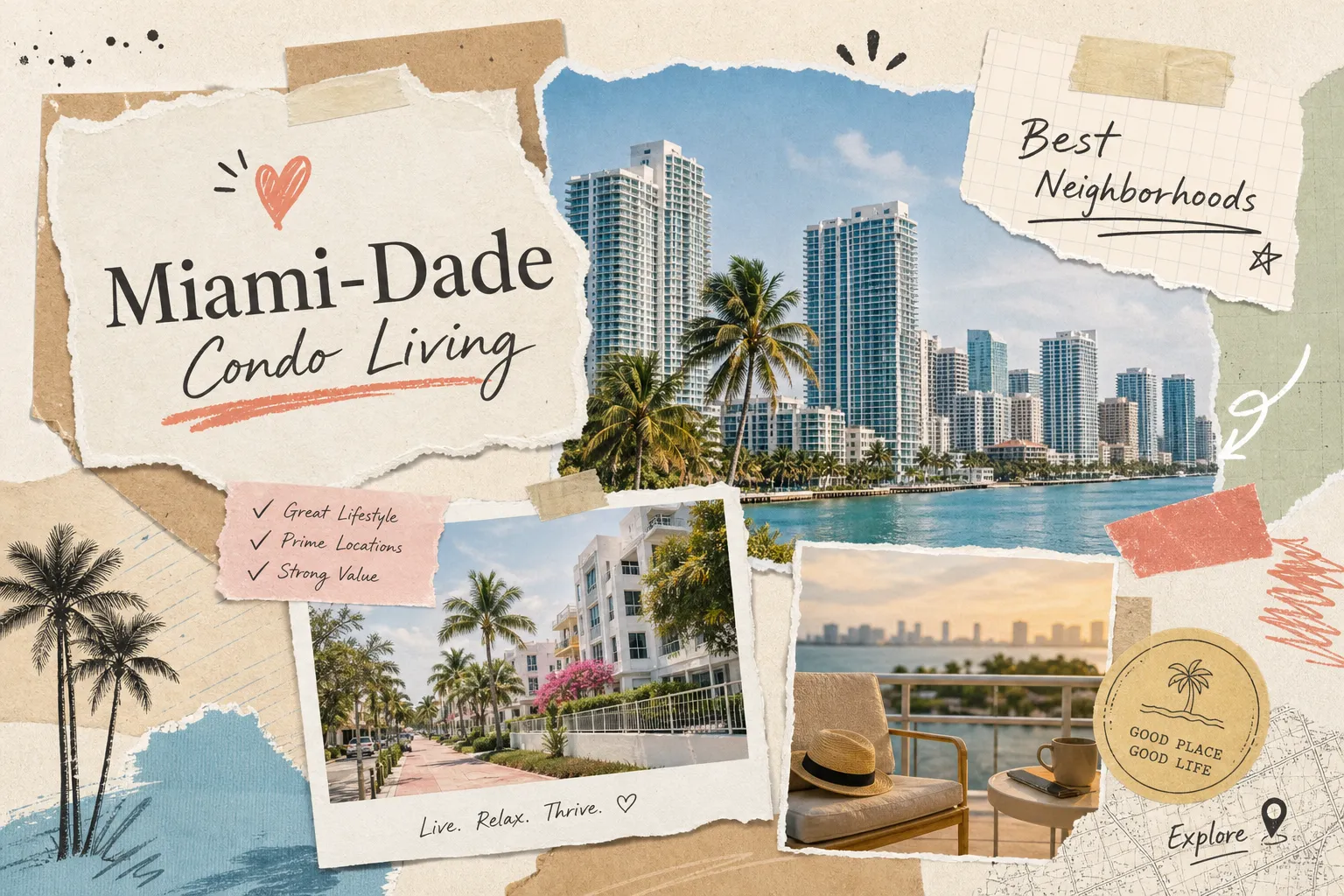
The best condo neighborhoods in Miami-Dade balance walkability, closed-sale value, and rental yield, and in 2026, the data makes clear distinctions between them. Brickell leads for urban professionals who want walkability and corporate rental demand. Edgewater delivers better value per square foot with genuine waterfront access. Sunny Isles Beach and Aventura serve oceanfront buyers at different price points, and Coconut Grove is the boutique pick for lifestyle over volume. These five neighborhoods cover the widest range of condo buyer priorities across Miami-Dade in 2026, and the data backs each claim with closed-sale figures, not asking prices.
This guide ranks nine Miami-Dade condo communities across price, walkability, rental yield, and investment merit. All price data used here comes from closed sales, the same live MLS tracking that powers the daily neighborhood reports and building-level profiles at Andres Jara | South Florida Luxury Real Estate. Asking prices are noted separately where the gap is worth flagging.
Key takeaways
- Brickell leads on walkability: Walk Score of 97 and Transit Score of 90 make it Miami-Dade’s most connected neighborhood for car-light living.
- Edgewater offers strong urban value: genuine waterfront access and newer product make it a compelling alternative to Brickell, with a tighter inventory trend.
- Coconut Grove is supply-constrained: limited active listings, a seven-figure closed median, and strong year-over-year sales growth signal robust demand in a boutique market.
- Sunny Isles Beach has a wide ask-to-close gap: asking prices sit well above what closed sales actually support, creating meaningful room for negotiation.
- STR yields require building-level verification: Municipality rules and condo declarations vary building by building; the highest gross yields exist only in explicitly permitted properties.
- Net yields shrink fast: After HOA fees, property taxes at roughly 9.5 mills, insurance, and management, luxury condo net yields typically land in the low single digits.
What the Miami-Dade condo market actually looks like right now
Miami-Dade remains a buyer-favorable market in 2026, but conditions vary sharply by submarket. Countywide, there are many thousands of active condo listings and roughly 14 months of supply, with the market median running near 55 to 60 days to contract for units that actually sell. A large share of inventory, however, simply sits unsold for far longer.
Closed condo sales are running modestly below the prior year, with occasional stronger months as active inventory gradually contracts. The broader pattern is volatile but slowly improving. This is not a broad recovery, and buyers who interpret one strong month as a trend shift risk overpaying.
Closed-sale medians across the county range from the mid-$400,000s in the most affordable oceanfront submarkets to around $2 million in Coconut Grove. Price per square foot spans from the low $300s in Aventura to well over $1,100 in Coconut Grove, with mid-range neighborhoods clustering in between. In most submarkets, asking prices run meaningfully higher than those closed figures. Use closed comps as your anchor.
How Miami-Dade’s best condo neighborhoods compare
The table below sorts neighborhoods from highest to lowest price per square foot on closed sales. Use it to identify your price tier quickly, then use the sections that follow for the full picture on lifestyle, commute, and rental yield.
NeighborhoodMarket tierWalk ScoreBest forCoconut GroveBoutique ultra-luxury74Lifestyle buyers, boutique luxurySouth BeachLifestyle / STR-eligibleHighSTR investors, lifestyleBrickellUrban mainstream luxury97Urban professionals, corporate rentalCoral GablesEstablished luxury60Families, established neighborhoodsDowntown MiamiWalkable urban91Walkability, transit accessEdgewaterWaterfront value89Value buyers, long-term rentersSunny Isles BeachOceanfront78Oceanfront, international buyersAventuraMaster-planned value64Value, master-planned lifestyleBal Harbour / Key BiscayneUltra-premiumVariesUltra-premium, privacy-first buyers
How you read this table depends on what you are trying to accomplish. Lifestyle priorities? Sort by Walk Score and neighborhood character. Investment focus? Zero in on yield range and inventory trend. Relocating for work? Compare price-per-square-foot efficiency against commute time to your office. The sections below address each cluster in that order.
Best condo neighborhoods in Miami-Dade, Urban Core: Brickell, Edgewater, and Downtown Miami
Brickell posts a closed-sale median around $625,000 at roughly $674 per square foot, with asking prices running higher. It is Miami’s densest corporate submarket, served by Metrorail, the free Metromover, and Brickell City Centre. Walk Score is 97 and Transit Score is 90, numbers no other Miami-Dade neighborhood matches. Full-service buildings carry HOA fees in the $1,800 to $3,500 per month range, with branded towers occasionally exceeding $4,000.
On the investment side, cap rates are modest and STR occupancy in compliant buildings can run high. Brickell has the county’s deepest short-term rental demand concentration, but most residential towers still impose 30-day or longer minimums. Recent deliveries, including Una Residences and 2200 Brickell, mean buyers should review building-level absorption data rather than neighborhood averages before committing.
Edgewater’s closed-sale median runs around $820,000 at roughly $737 per square foot, reflecting its newer, larger waterfront product. Active inventory has tightened year over year, among the fastest rates of any urban-core neighborhood. Walk Score is 89, waterfront access is genuine, and the Aria Reserve twin towers have begun establishing concrete rental and resale benchmarks for the area. Gross rental yields are solid, with strong demand from the same corporate workforce. Buyers seeking genuine waterfront access near Brickell will find Edgewater to be a compelling play in the best areas to buy a condo in Miami’s urban core.
Downtown Miami posts a Walk Score of 91 and a Transit Score of 94, the county’s top transit figures. Pricing runs in the mid-range among urban-core neighborhoods, and sales volume has grown modestly year over year. The trade-off is direct competition from a wave of new construction: Casa Bella by B&B Italia and The Elser Hotel & Residences both delivered in 2026, adding contemporary comparables that put pricing pressure on older resale stock. Cap rates track roughly in line with Brickell.
Best condo neighborhoods in Miami-Dade, Waterfront Picks: Sunny Isles Beach, Aventura, and the Ultra-Premium Tier
Sunny Isles Beach posts a closed-sale median around $595,000 at roughly $660 per square foot. Asking prices sit well above that, reflecting a wide gap between seller expectations and what the closed-sale record actually supports. Luxury high-rises here carry HOA fees of $2,000 to $5,000 per month for resort-style buildings, with larger units in ultra-premium towers reaching $6,000. The neighborhood draws heavily from Latin American and European buyers seeking oceanfront second homes or wealth preservation assets, and seasonal furnished-rental demand is strong. Building-specific STR rules vary significantly and must be verified against the condo declaration before any investment underwriting.
Aventura is the most affordable entry point in this tier, with a median around $447,500 at roughly $372 per square foot on closed sales. Intracoastal access, proximity to both Miami and Fort Lauderdale airports, Aventura Mall, and a range of communities from mid-rise to full-service luxury make it one of the most versatile Miami-Dade condo communities available. Cap rates are modest, long-term rental demand is stable, and the entry point allows buyers to allocate more budget toward unit size or reserves rather than the land cost embedded in oceanfront addresses.
When privacy matters more than price, Bal Harbour and Key Biscayne represent the ultra-premium tier. Bal Harbour closes well above $1,400 per square foot, with active inventory tightening year over year. Key Biscayne has recorded a strong year-over-year increase in sales volume, with closed pricing well into four figures per square foot. HOA fees in full-service buildings at both addresses routinely exceed $2,000 per month.
Lifestyle-first picks: Coconut Grove, Coral Gables, and South Beach
Coconut Grove is the most unusual neighborhood in this guide. It has very limited active inventory, a closed-sale median around $2 million at well over $1,100 per square foot on closed transactions, and some of the strongest sales growth in Miami-Dade. Asking prices run higher still. Competitive offers are common, and buyers entering with a comps-anchored bid will move faster than those relying on asking prices. Gross rental yields run 3, 4%: this is a lifestyle purchase that holds value, not a cash-flow play.
Coral Gables prices around $870 per square foot on closed sales, with a historic, tree-canopied character that draws families and executives relocating from northeast U.S. markets, a pattern supported by the neighborhood’s consistent absorption rate relative to its limited new supply. HOA fees in Coral Gables mid-rises typically run $400 to $800 per month, substantially below the urban high-rise tier. Walk Score is 60, which means a car remains part of daily life, but the trade-off is space, architectural character, and proximity to the University of Miami alongside a deep base of established employers.
South Beach pricing runs in the mid-range on closed sales, with STR-eligible buildings capable of some of the highest gross yields in the county. Regulatory constraints, building restrictions, and operating costs bring net yields for compliant properties considerably lower. Miami Beach broadly prohibits vacation rentals under six months and one day in residential properties, so STR feasibility depends entirely on the specific building’s declaration and its municipal designation. Verify both before purchasing with rental income in mind.
Which Miami-Dade condo neighborhoods make the strongest investment case
Realistic gross yields for Miami-Dade condos are modest for most neighborhoods. Net yields on luxury coastal buildings often fall to the low single digits after HOA fees, property taxes at approximately 9.5 mills countywide, insurance, and management costs. On a $500,000 taxable value, property taxes alone add roughly $4,800 annually before any city-level levies or non-ad valorem charges. Investors who model gross yield without accounting for carrying costs will underwrite at the wrong number.
Edgewater and Brickell offer the deepest long-term rental demand pools among the best areas to buy a condo in Miami. Wynwood and Midtown show some of the highest STR upside, but carry the most regulatory and operational risk. Doral and Kendall, outside the luxury tier, post stronger gross yields with more favorable cash-flow math. No investor should underwrite any building without verifying the condo declaration’s rental restrictions alongside local municipality rules. Two buildings on the same Brickell block can produce materially different yields based on their HOA fee structure, unit mix, and rental policy.
The right next step for every buyer type
The best condo neighborhoods in Miami-Dade for 2026 depend entirely on what you are optimizing for. Brickell and Edgewater lead for urban professionals who want walkability and rental demand depth. Sunny Isles Beach and Aventura serve oceanfront buyers at different budget tiers. Coconut Grove and Coral Gables suit buyers who prioritize neighborhood character over condo density. South Beach is the strongest STR play where building rules permit it, and Bal Harbour or Key Biscayne serve ultra-premium buyers for whom exclusivity is the primary criterion.
Neighborhood research narrows the field, but building-level data closes the deal. Andres Jara | South Florida Luxury Real Estate covers all 76 South Florida submarkets with daily-refreshed MLS data, live neighborhood guides, and building-level profiles for communities spanning the full range of Miami-Dade condo neighborhoods. Whether you are shortlisting three areas or ready to tour specific units, reaching out directly to Andres puts 24 years of South Florida experience, bilingual English and Spanish service, and Douglas Elliman’s full luxury network behind your search.
Frequently Asked Questions
Can I run a short-term rental in a Miami-Dade condo?
Sometimes — short-term rental eligibility varies building by building and by municipality. I note that the highest gross STR yields exist only in explicitly permitted properties, and Miami Beach broadly prohibits vacation rentals under six months and one day, so you must verify the condo declaration and local rules before underwriting any STR strategy.
Which Miami-Dade neighborhoods are the best for walkability and transit access?
Brickell is the top pick for walkability and transit, followed closely by Downtown and Edgewater. I report Brickell with a Walk Score of 97 and Transit Score of 90, Downtown with Walk 91 and Transit 94, and Edgewater with a Walk Score of 89, making them the strongest urban options for car-light living.
Should I use asking prices or closed sales when valuing a condo?
Use closed sales as your anchor because asking prices generally run meaningfully higher than closed figures. I note that closed-sale medians and price-per-square-foot metrics are the data that support realistic valuation, and that Sunny Isles Beach and multiple neighborhoods show wide ask-to-close gaps that create negotiation room.
How do HOA fees and taxes affect investment yield for Miami-Dade condos?
HOA fees and taxes materially reduce net yields, often pushing luxury condo net yields down to the low single digits. I explain that full-service HOA ranges can be $1,800–$3,500 monthly (or higher in branded towers), property taxes run at roughly 9.5 mills, and on a $500,000 taxable value taxes alone add about $4,800 annually before other carrying costs.