
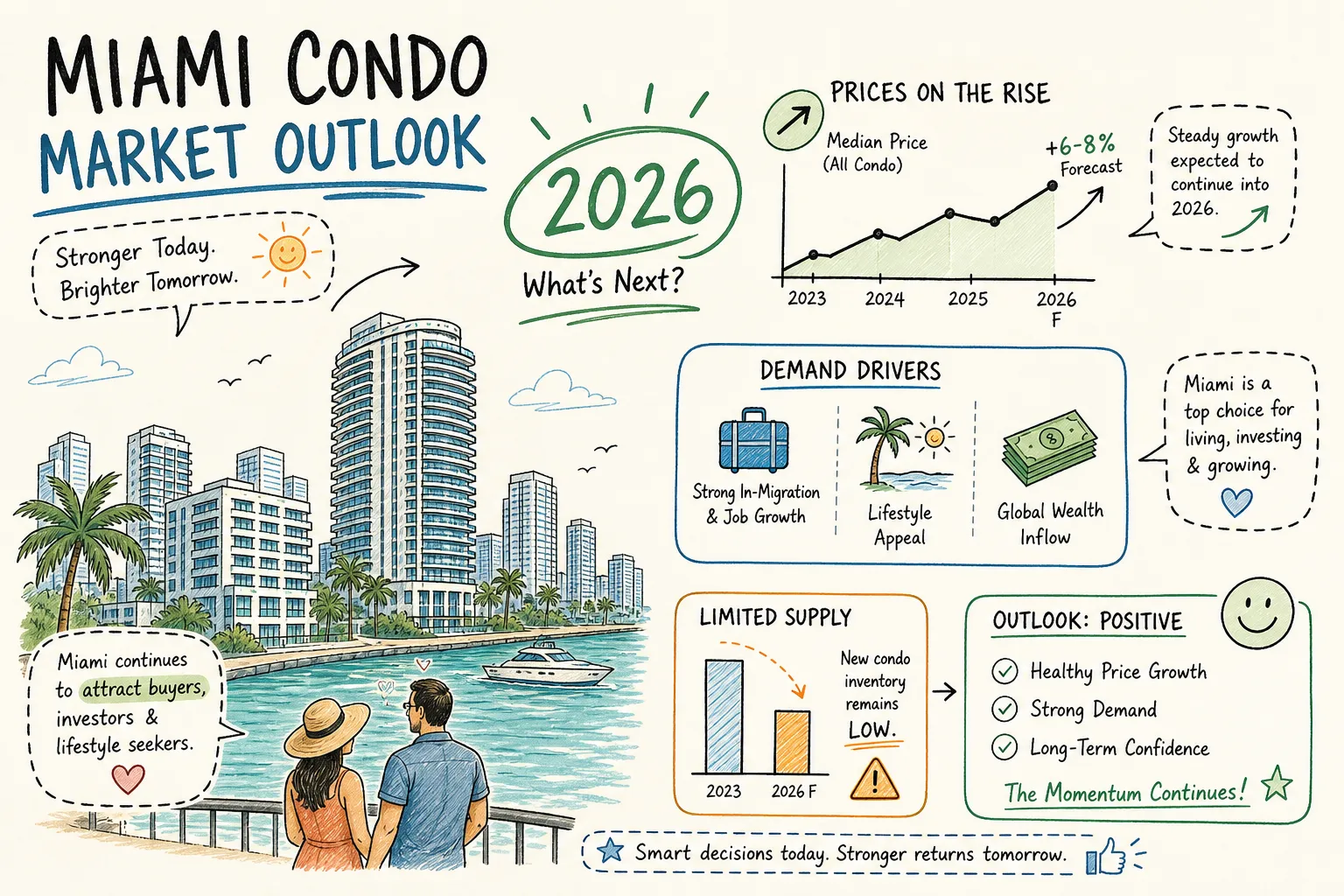
Miami’s condo market in 2026 is a tale of two realities. Luxury buyers face rising prices in select submarkets while carrying real negotiating leverage in others, and sellers are working in a market that rewards precision pricing over wishful thinking. The numbers tell a nuanced story: the $1M-plus luxury segment has held its pricing with modest gains, while condo inventory across Miami-Dade, though easing from its highs, still sits well above a balanced level. This report pulls from daily-refreshed MLS data, including the building-level analytics that power Andres Jara’s South Florida market intelligence platform, to give you a ground-level read on what the numbers actually mean right now.
What follows covers pricing by segment, inventory trajectory through Q3 2026, the neighborhoods outpacing the broader market, absorption rates by product type, and the demand forces shaping it all. Whether you’re a buyer evaluating your timing, a seller setting your ask, or an investor reading the opportunity, the data here gives you a starting point for a sharper decision.
Key takeaways
- Luxury prices holding: The $1M-plus segment has held its median with modest year-over-year gains, even as price per square foot softened slightly.
- Inventory tightening: Miami-Dade condo listings have eased from their highs, but at roughly 14 months of supply, buyers still hold real leverage.
- Neighborhood divergence is sharp: some submarkets posted annual price gains while others softened, making submarket selection critical.
- Cash dominates the upper tiers: the large majority of $1M-plus condo closings are all-cash, and the cash share climbs with price, which blunts the impact of interest-rate moves on luxury demand.
- New construction absorbs slowly: Newly delivered Brickell and Downtown buildings take considerably longer to sell than established inventory.
- Standout neighborhoods: Edgewater, Coral Gables, Coconut Grove, and Fisher Island led on sales growth and price appreciation in 2026.
Miami Condo Market 2026: What Are Prices Actually Doing?
Luxury segment versus the broader market
The $1M-plus luxury condo segment has held its median with modest year-over-year gains, even as the median price per square foot for that tier has softened slightly. That spread between total price and per-square-foot movement tells a specific story: larger units are closing at higher totals, but the per-unit efficiency has softened. Buyers in this segment are acquiring more square footage at a slight discount on a per-foot basis, which matters when you’re evaluating value against comparable properties.
The broader Miami-Dade condo market spans an enormous range of product across the county’s many submarkets, from entry-level inland units to eight-figure waterfront residences. Submarket divergence is significant: some coastal submarkets posted annual price increases while others softened in the same period. County-level averages mask these swings entirely, which is precisely why building-level and neighborhood-level data matters more than headline figures when you’re making decisions at this price point.
Cash buyers are setting the pricing floor
A large share of Miami condo transactions are cash purchases, and that share climbs steeply with price, reaching the clear majority at the top of the market. That cash dominance continues to shape how the 2026 market behaves.
This level of cash dominance changes the dynamics at the top of the market in a specific way. Sellers of premium units are dealing with a buyer pool that doesn’t depend on rate movement, which means interest rate fluctuations have far less influence on luxury demand than many expect. Buyers competing with cash offers need to understand how that shapes seller expectations on timelines, contingencies, and pricing flexibility.
Miami Condo Market 2026: Inventory Outlook
How supply shifted from early to late 2026
Miami-Dade condo inventory climbed through years of supply accumulation and has more recently begun to ease as the market absorbs listings at a faster pace. Months of supply has drifted toward roughly 14 months countywide, still well above a balanced level.
The tightening trend is real, but the pace still matters. Miami-Dade is absorbing inventory, but it entered 2026 from an elevated base and the drawdown has been gradual. The new construction pipeline adds another layer, with thousands of units delivering across 2025 through 2027 and Brickell and Edgewater absorbing the majority. That supply is arriving into a market already carrying well over a year of condo inventory in many submarkets.
What 12+ months of supply still means for buyers and sellers
A balanced condo market runs between six and nine months of supply. Miami is sitting around 14 months countywide, with significant variation by submarket: Downtown Miami and Brickell carry the heaviest inventory, running well over two years of supply, while Coral Gables and Coconut Grove are the outliers at roughly 8 and 7 months respectively, the closest any Miami submarkets came to balanced conditions in 2026.
For buyers, this environment rewards patience and data. MLS data shows resale condos are generally pricing contracts below list, and sellers who price ahead of comparables are sitting longer. For sellers, the difference between accurate pricing and aspirational pricing is not a matter of a few extra days on market, it typically means significantly longer time on market and a higher likelihood of price reductions. The tightening trend is real and meaningful, but this is not yet a seller’s market, and 2026 data does not support pricing as if it were.
Miami Condo Market 2026: Neighborhood Winners
Where transactions accelerated most
Edgewater led all individual neighborhoods on sales growth, with closed condo sales jumping sharply year over year. Coconut Grove posted some of the strongest luxury-segment sales growth, and Coconut Grove and Coral Gables together recorded a strong increase in closed sales. These are closed-transaction counts, not projections, which makes them the most reliable signal of where buyer conviction is highest.
Miami Beaches as a broader submarket posted solid condo sales growth across several consecutive quarters, alongside a modest median price increase. These neighborhoods share a common thread: limited new supply relative to demand, walkable or waterfront locations, and strong fundamentals for both primary residents and second-home buyers.
Where values moved the most
Fisher Island led all neighborhoods on price-per-square-foot appreciation, cementing its position as Miami’s most expensive condo submarket. Coral Gables posted some of the strongest median price growth in the luxury segment, and Coconut Grove and Coral Gables combined showed solid median price appreciation.
Through 2026 these neighborhoods carried some of the tightest supply in the county, in the range of seven to nine months, as inventory gradually built through the summer. For investors and buyers focused on long-term value preservation, these are the locations where both demand and pricing discipline are holding firm. The data from these submarkets also confirms that neighborhood selection in 2026 is a far more consequential decision than it was when the broader market was rising uniformly.
How fast are Miami condos actually moving right now?
Across Miami-Dade, the median time from listing to contract runs in the neighborhood of 55 to 60 days, with additional time to reach closing. At the neighborhood level, Bal Harbour luxury condos run close to 90 days to contract, Sunny Isles Beach around 100, and the thin ultra-luxury tier can stretch well beyond that.
New construction tells a different story. Newly delivered buildings in Downtown and Brickell take considerably longer to sell than established buildings and close at roughly 90% of original list price. Pre-construction units take longer still to reach a binding contract, with the highest-priced tiers taking the longest. Buyers considering pre-construction commitments should factor those extended absorption timelines directly into their unit value expectations at delivery.
Market / product typeDays to contractMonths of supplyNotesMiami-Dade (all condos)~55-60 days~14 monthsTrailing-12-month dataCoral GablesTighter~9 monthsClosest to balanced market in MiamiCoconut GroveTighter~7 monthsStrong luxury sales growthBrickellSlower~29 monthsHeavy new-construction pipelineDowntown MiamiSlowestHeaviestHighest inventory burden in MiamiBal Harbour (luxury)~88 daysElevatedLuxury condosSunny Isles Beach (luxury)~104 daysElevatedLuxury condosNew builds (Downtown/Brickell)Much longerHeavyClose at ~90% of original list
What’s driving demand in Miami’s condo market this year?
Domestic relocation and tax-driven migration
Florida’s zero state income tax remains a structurally powerful demand driver, particularly for buyers relocating from New York, California, and Illinois. Those three states account for a large share of domestic out-of-state buyers in the South Florida luxury market, with New York representing the single biggest source. High-earning professionals, finance executives, and remote-capable earners continue to represent a large share of the Miami luxury condo buyer pool in 2026, typically targeting primary residences or pied-à-terre options in Brickell, Edgewater, and Sunny Isles Beach.
These buyers arrive with cash, pre-qualified financing, and, increasingly, a clear picture of which buildings meet their criteria before they ever step on a plane. Their decision-making is data-first, and their expectations of agent expertise are high. They want building-level comparables, floor plan analysis, and closed-sale history, not neighborhood averages from a public portal. Preferred building profiles tend to skew toward full-service, amenity-rich towers with strong HOA financials and active rental programs.
International and Latin American buyer activity
Latin American buyers from Venezuela, Colombia, Brazil, and Argentina continue to treat South Florida luxury condos as a preferred vehicle for wealth preservation, second-home ownership, and U.S.-based investment. International buyers represent a large share of Miami-Dade luxury real estate sales and an even larger share of new-construction and pre-construction sales. The high all-cash rate at the $1M-plus tier is partly a reflection of this buyer group, which often purchases without U.S. financing.
Bilingual service, off-market access, and building-level research are not optional preferences for this segment; they are practical requirements. Demand from international buyers remains a stabilizing force in Miami’s luxury condo market, particularly in Bal Harbour, Aventura, and Sunny Isles Beach, where Latin American and European buyers have long established concentrated ownership.
Where do serious buyers and sellers get real data beyond the public portals?
Public portals surface list prices and general neighborhood medians. They do not show you closed-sale history by building, per-unit absorption rates, floor plan comparisons within the same stack, or off-market inventory. In a market where a unit on floors 10 and 40 of the same building can trade at very different per-square-foot values, the gap matters. When roughly 14 months of supply at the county level masks the difference between a single-digit Coral Gables submarket and a Downtown Miami submarket carrying years of supply, broad portal data is not enough to make a confident decision at $800K, $3M, or $10M.
Andres Jara’s South Florida platform refreshes daily from building-level research, covering condo buildings and South Florida neighborhoods across Miami-Dade, Broward, and Palm Beach. The building-level profiles include unit inventory, floor plans, closed-sale history, and amenity data. The platform also includes an AI-powered advisor that answers specific questions using live market data, from what a specific unit closed for in the last 12 months to the current absorption rate for two-bedrooms in Edgewater. For anyone navigating the miami condo market 2026 landscape and needing real-time intelligence beyond what any public portal provides, that level of granularity is what separates a confident decision from an expensive guess.
The bottom line on Miami condos in 2026
Prices in the luxury segment are holding with modest gains. Inventory is tightening from elevated levels but still favors buyers at roughly 14 months of supply countywide. The strongest neighborhood performance is concentrated in Edgewater, Coconut Grove, Coral Gables, and Fisher Island, while Downtown Miami and Brickell carry the heaviest supply burdens heading into a wave of new deliveries through 2027. New construction is absorbing more slowly than established inventory, and cash buyers continue to dominate the upper tiers. The 2026 Miami condo market rewards precise, building-level research over broad assumptions, in every direction.
Sellers who price against true internal comparables rather than county-level medians are closing faster and with fewer concessions. Buyers who understand submarket supply dynamics before touring are negotiating from an informed position. Investors who can read absorption rates and new-build pipelines by neighborhood are identifying where value is holding and where risk is quietly building.
If you’re buying, selling, or evaluating an investment in Miami’s condo market right now, the data in this report is a starting point. For daily-refreshed, building-level analytics or a direct conversation about your specific property or target building, reach out to Andres Jara at South Florida Luxury Real Estate. He brings over two decades of South Florida experience, bilingual English and Spanish service, and access to off-market inventory across buildings, the kind of market intelligence that simply does not show up on any public portal.
Frequently Asked Questions
Will the new construction pipeline significantly increase overall condo supply in 2026 and 2027?
Yes, a meaningful amount of new supply is arriving, with thousands of units delivering across 2025 through 2027. Much of that pipeline lands in Brickell and Edgewater, which matters because those submarkets already account for heavy new-delivery absorption and higher months-of-supply.
Is Miami’s 2026 condo market a seller’s market right now?
No, the market in 2026 is not a seller’s market; countywide months of supply sits around 14 months, which still favors buyers. Sellers who price accurately against true comparables close faster, while aspirational pricing typically results in much longer time on market and higher likelihood of reductions.
Which neighborhoods are most reliable for long-term value preservation?
Edgewater, Coral Gables, Coconut Grove, and Fisher Island are the neighborhoods showing the strongest sales growth and price appreciation in 2026. These areas combine limited new supply, walkable or waterfront locations, and tighter months-of-supply compared with much of the county, supporting both demand and pricing discipline.
How does absorption and time on market compare between new construction and established condos?
New construction in Downtown and Brickell is absorbing more slowly than established inventory. New-build closings tend to settle at about 90% of original list price, and pre-construction units show longer contract timelines, especially at the highest price points.