
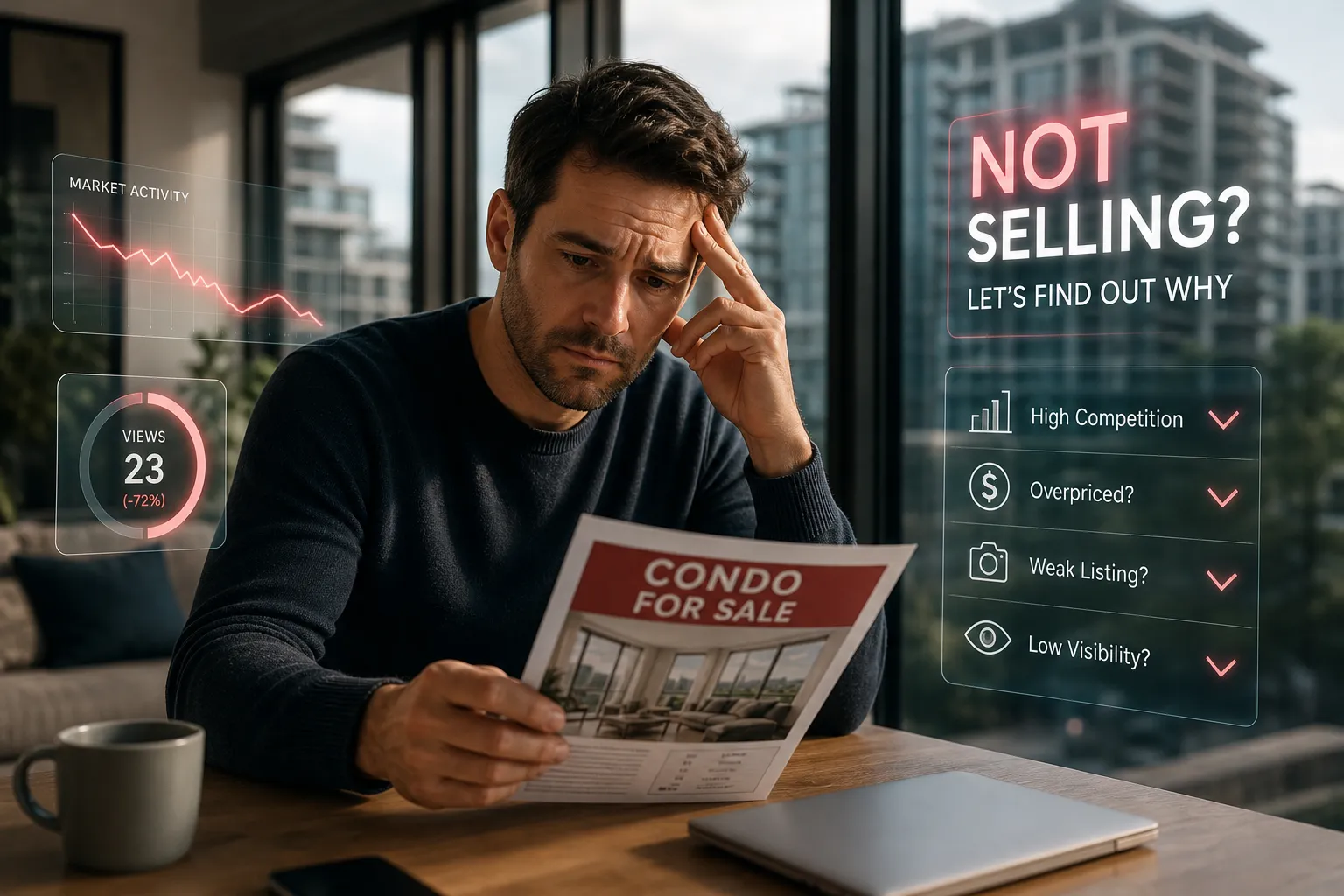
If you’re asking why isn’t my condo selling, the answer usually comes down to one of five fixable problems: the price is off relative to same-building comparables, the building’s finances are deterring buyers or lenders, HOA rules are narrowing the eligible buyer pool, the marketing isn’t reaching the right audience, or the listing launched at the wrong moment against too much in-building competition. Identifying the actual cause is what separates a condo that closes in 30 days from one that expires unsold.
Random adjustments won’t fix a structural problem. A cosmetic price cut that keeps your unit in the same search bracket changes nothing. New photos won’t overcome a non-warrantable building. Work through the five diagnostic areas below, identify which ones apply to your situation, and you’ll know exactly what to fix and in what order.
Key takeaways
- Price against same-building comps: Neighborhood averages mask per-unit variation; closed sales within your building from the last 60–90 days are the most reliable pricing benchmark.
- HOA finances matter to lenders: Weak reserves, pending assessments, and open litigation can block buyer financing even when your unit is priced and marketed correctly.
- Project approval rules changed in 2026: Fannie Mae and Freddie Mac eliminated the “limited review” process in August 2026, increasing documentation requirements and denial risk across the condo market.
- Marketing reach determines showings: Professional photography and complete MLS syndication generate the most measurable showing activity; virtual tours convert remote and relocating buyers before they ever visit.
- Timing and in-building competition compound everything: Launching when multiple comparable units are already active in your building forces a price-and-condition battle you can only win with clear differentiation.
Why isn’t my condo selling? Start with the price
Why neighborhood averages mislead condo sellers
Many sellers price their unit by looking at what condos sold for “in the area.” That number is nearly useless when buyers can sort competing units by floor, view, exposure, and condition inside the same building. A two-bedroom on the 12th floor with a city view and a two-bedroom on the 28th floor with direct ocean views do not share the same market value, even when they share a zip code. Buyers in a condo building see their choices side by side, and they spot overpricing faster than buyers comparing detached homes across different blocks.
What building-level data actually shows
The most reliable pricing benchmark is same-building closed sales from the last 60–90 days, adjusted for floor, line, view, parking, storage, finishes, HOA amount, and condition. (When no recent in-building sales exist, the next best option is truly comparable nearby buildings with careful adjustments.) We track closed-sale history for South Florida condo buildings through a building-level research, which gives sellers the building-specific comparables that a neighborhood average cannot provide. Sellers who start with that precision avoid the stale-listing spiral: price too high, wait, reduce, wait, reduce, and eventually sell for less than a correct day-one price would have netted.
The review timeline that kills offers
The first 10–14 days of a listing generate the strongest online attention and showing activity. No showing requests after roughly 10 days is a clear signal that the price is missing the market. A listing that crosses 30 days with no offers also carries a perception problem, because buyers ask why it has been sitting. Any price reduction should move your unit into a meaningfully larger buyer-search bracket; a small cut that leaves it competing against the same group of listings accomplishes almost nothing.
How HOA fees and reserve health affect your buyer pool
High HOA dues raise a buyer’s total monthly payment, which reduces what they can qualify for and narrows the interested buyer pool from the start. A unit with fees materially above comparable buildings in the same submarket will face longer marketing times or require a lower sale price to offset the cost differential. The math compounds quickly when a buyer is already stretching to reach a purchase price.
Beyond high fees, buyers and their lenders scrutinize reserve fund adequacy, deferred maintenance, pending special assessments, and open litigation. Each of these signals financial instability in the building and triggers hesitation even when the unit itself shows well. A building with underfunded reserves can produce a financing denial after the seller is already under contract, the worst possible moment to discover the problem.
How rental restrictions narrow your buyer pool further
Rental caps, short-term leasing bans, and minimum owner-occupancy requirements shrink the eligible buyer pool, complicate financing, and limit future resale flexibility. Sellers often don’t realize these restrictions are a deterrent until showings produce interest but no offers. Being upfront about rental eligibility in the listing filters in the right buyers rather than consuming time on buyers who will walk once they read the HOA rules.
Is your building blocking the sale without you knowing it?
A condo can be priced correctly, marketed well, and attract a motivated buyer and still not close because the building itself is ineligible for conventional financing. Lenders evaluate the building’s insurance, reserve balances, owner-occupancy ratio, and investor concentration. They also assess commercial exposure and pending litigation before approving a loan. This project-level review is entirely separate from the buyer’s personal creditworthiness, and a denial here affects every unit in the building, not just yours.
The risk increased substantially in August 2026, when Fannie Mae and Freddie Mac eliminated the “limited review” process.. With it gone, more transactions now require full project underwriting, which increases documentation requirements, delays, and denial rates across the condo market.
The practical fix is to treat building eligibility as a pre-listing due-diligence item. Before going live, request the HOA budget, reserve study, master insurance policy, recent meeting minutes, litigation disclosures, and a completed lender questionnaire. Have a mortgage professional or condo-underwriting specialist review those documents before you accept an offer. A seller who can hand a buyer’s lender a clean documentation package closes faster and negotiates from a stronger position than one who discovers a problem under contract.
Why isn’t my condo selling? Check whether buyers are finding it
Professional photography is not optional in a market where buyers filter listings online before booking a single showing. In South Florida’s luxury condo market, buyers from New York, California, Latin America, and Europe regularly make initial decisions remotely before visiting in person. The first photo in your listing determines whether a buyer clicks or scrolls past, and every other element of your marketing depends on getting that click.
A 3D virtual tour addresses a specific challenge in this market: a large share of buyers are relocating or investing from out of state or internationally, and a virtual tour lets them qualify the property before making the trip. Beyond tours, MLS syndication must be accurate and complete. Your listing should include HOA fees, reserve status, assessments, pet policy, rental eligibility, parking, amenities, and financing eligibility on every portal where it appears. Missing this information creates friction that most sellers never trace back to their own listing.
Marketing tacticPrimary benefitKey requirementProfessional photographyDrives more clicks and showing requestsStrong first photo; include views, amenities, and building entrance3D virtual tourConverts remote and international buyersFull-unit walkthrough plus building common areasMLS syndicationReaches the broadest active-buyer poolComplete condo details: fees, pets, rentals, financing eligibilityTargeted digital adsSupplements MLS with specific buyer segmentsDefined budget, retargeting, measured by showings, not clicks
Did timing or in-building competition work against you?
Historically, January through April generates the strongest buyer activity in South Florida’s condo market, with February and March typically the peak months. Buyer traffic begins building in November and December as seasonal residents arrive, then accelerates after the holidays. A listing that launched in mid-summer faces thinner demand and a weaker negotiating position, even when the unit and the price are both right. If you launched at the wrong time and the listing went stale, a thoughtful relaunch timed to the winter season is a legitimate strategic move, not just a cosmetic refresh.
One of the most underappreciated condo resale problems is listing when multiple comparable units in the same building are already active. Buyers compare nearly identical floor plans side by side and gravitate toward the best-priced, best-presented option. The more similar the competing units are on floor, line, view, and condition, the more directly they compete on price alone. Sellers who review in-building inventory before launching can time their entry strategically and position their unit with condition, inclusions, and presentation that differentiate it within its own competitive set rather than racing to the bottom on price.
What to do now: a short action plan
If your condo isn’t selling, it frequently comes down to one or more of the five areas above, and many sellers are dealing with a combination of two or three at the same time. The corrective actions for each are different. Fixing pricing has the highest immediate leverage, but pricing correctly requires same-building data, not neighborhood averages. After that, building eligibility, marketing quality, and launch timing each need honest assessment before you make another move.
- Pull closed-sale data from your specific building for the last 60–90 days, adjusted for floor, line, view, and condition. If your price falls outside that range, reprice meaningfully into a larger search bracket, not cosmetically.
- Request the HOA’s reserve study, current budget, master insurance certificate, and litigation status. Have a lender review the project before accepting the next offer.
- Audit your listing for professional photography, a complete 3D virtual tour, and full condo details on every portal where it appears.
- Check active competing inventory in your building before relaunching. If several similar units are already listed, differentiate on price, condition, or presentation, then relaunch.
We bring 24 years of South Florida market experience and a live database covering closed-sale history across condo buildings to every listing conversation. If you want a building-level comparable sales analysis, a frank assessment of what your unit is actually competing against, and a pricing strategy grounded in real data rather than zip-code averages, contact Andres Jara and the South Florida Luxury Real Estate team directly. The goal is simple: price it right once, market it to the right buyers, and close it.
Frequently asked questions
Why isn’t my condo selling even when it’s priced fairly?
Pricing is only one variable. A unit priced fairly by neighborhood standards may still be overpriced relative to same-building closed sales. Beyond price, building-level financing eligibility, HOA restrictions, and marketing gaps each independently prevent closings. Run through all five diagnostic areas before concluding price is the sole issue.
Why won’t my condo sell when similar units have closed nearby?
Nearby sales in a different building or on a different floor carry limited relevance. Buyers inside a condo building compare floor, line, view, and condition unit by unit. If your building has HOA financial issues or project-approval problems, those factors override comparable sales in a neighboring building entirely.
How can I sell my condo faster in a slow market?
The highest-leverage steps are repricing to a same-building benchmark, resolving any known building-eligibility issues before going to market, upgrading photography and virtual-tour coverage, and timing your launch for South Florida’s peak season between January and April. Each improvement targets a different buyer objection and compounds when done together.