
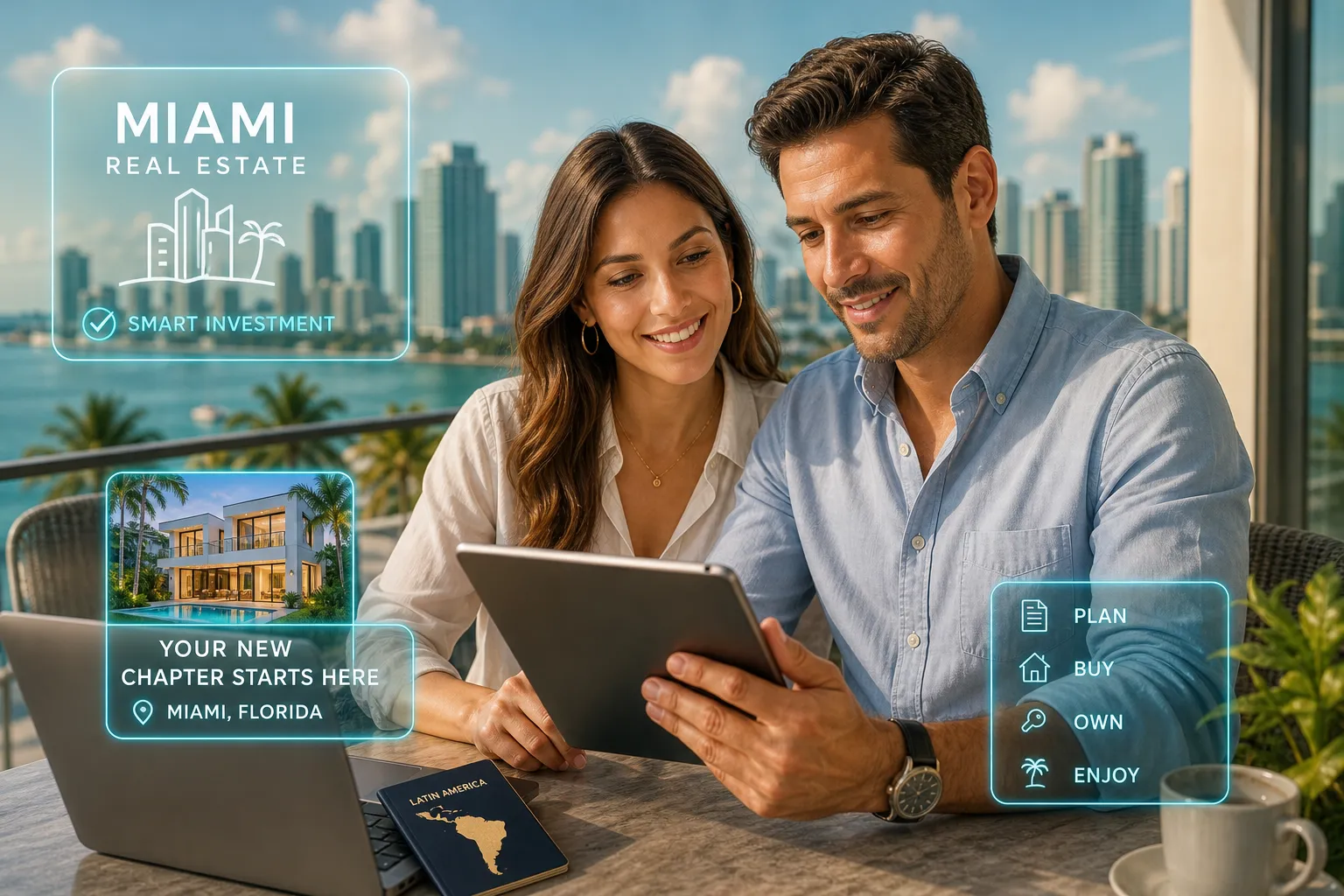
Buying Miami real estate from Latin America involves five distinct steps: (1) choose your legal ownership structure, (2) secure financing or document your cash position, (3) transfer funds safely to the U.S. (4) understand your tax obligations before and after closing, and (5) research and close on the property, all without needing to fly in. Each step has specific requirements that differ from a domestic purchase, and getting them out of order costs time and money.
Latin American buyers accounted for 86% of Miami’s foreign real estate purchases between 2024 and late 2025, led by buyers from Colombia, Argentina, Brazil, and Mexico (per the National Association of Realtors’ international buyer data). The demand makes sense: Florida has no state income tax, the state offers landlord-friendly statutes and strong property-rights protections relative to many U.S. jurisdictions, and Miami’s international character makes it one of the most accessible U.S. markets for foreign nationals. The process is well-documented and repeatable, but only when you start with the right information: lender pre-approval, title-company instructions, and association documents reviewed before you sign anything.
Key Takeaways
- Structure before signing: Holding Miami property through a U.S. LLC may change your estate-tax exposure and simplifies future ownership transfers without requiring a new deed. Consult a U.S. tax adviser and Florida attorney before choosing your structure.
- Expect 30–40% down: Foreign national portfolio loans are the realistic financing path for non-residents; conventional U.S. mortgages require credit history and residency status most Latin American buyers won’t have.
- Wire legally, document everything: Transfer funds through regulated bank channels with full source-of-funds documentation. Breaking transfers into smaller amounts to avoid bank review is a federal crime.
- FIRPTA applies when you sell: When a foreign person sells U.S. real property, the closing agent withholds 15% of the gross sale price and remits it to the IRS. Planning for it starts at purchase.
- Remote closing is standard: Florida title companies routinely close transactions through mail-away signing, consular notarization, or a power of attorney with apostille.
- SB 264 affects Cubans and Venezuelans: Most Latin American nationalities are not restricted, but Venezuelan and Cuban nationals should confirm eligibility with a Florida attorney before signing.
Buying Miami Real Estate from Latin America: Legal Structure Options
LLC vs. Individual Title
Most Latin American buyers choose between taking title individually and forming a U.S. LLC before closing. Direct ownership is simpler to establish, but it can expose the buyer to U.S. federal estate tax on the full property value, a liability that can reach 40% for non-residents. The estate-tax consequences of holding U.S. real estate through an LLC are complex and fact-specific; an entity structure may change your estate-tax exposure and reporting obligations, but it is not a guaranteed shield. Consult a qualified U.S. tax adviser and Florida attorney before deciding. Beyond the tax question, an LLC does add liability protection and can allow future ownership transfers without triggering a new deed or documentary stamp tax.
A Florida LLC costs a few hundred dollars to form and requires an annual state report filing. The buyer must also obtain an Employer Identification Number (EIN) from the IRS, open a U.S. bank account in the LLC’s name, and ensure the LLC is listed as the purchasing entity on the contract before signing. For cash buyers, this process is straightforward. For financed purchases, the lender must underwrite the LLC as the borrower, which adds documentation requirements.
Florida SB 264 and Nationality Restrictions
Florida’s Senate Bill 264, in effect since July 2023, restricts certain foreign nationals from purchasing real estate within 10 miles of military installations or critical infrastructure. Among Latin American nationalities, Venezuelan and Cuban nationals are most directly affected. Depending on domicile, ownership ties, and property location, a buyer affidavit or additional disclosures may be required at closing, confirm the specific requirements with a Florida real estate attorney before signing. Most Colombian, Argentine, Brazilian, and Mexican buyers are not restricted by SB 264, but verification from a Florida attorney remains the right move before executing any contract.
Buying Miami Real Estate from Latin America: Financing Options
Foreign National Portfolio Loans
U.S. conventional financing requires a Social Security number, domestic credit history, and income verifiable through U.S. tax returns. Most Latin American buyers without U.S. residency won’t meet those criteria. The practical path is a foreign national portfolio loan, offered by private and regional lenders who evaluate international bank statements, a foreign credit reference or accountant letter, and liquid assets in place of domestic tax returns.
Budget a minimum of 30% down for a Miami condo purchase, with 35–40% more common. New construction and non-warrantable buildings can push that requirement to 50%. On top of the down payment, most lenders require 12–24 months of projected housing payments held in reserve, covering principal, interest, property taxes, insurance, and HOA dues. Closing costs typically add another 3–5% of the purchase price, an illustrative range that can vary by county, lender, and transaction type.
Required Documentation
Foreign national lenders commonly request six to twelve months of bank statements from a regulated home-country institution, a signed letter from an employer or accountant confirming income, a foreign credit reference, a copy of the passport, and documentation tracing the source of the down payment. When the lender or title company requests it, certified English translations of all Spanish-language documents must be provided. Confirm translation requirements directly with your lender and title company early in the process.
How Do You Legally Move Money from Latin America to a U.S. Closing?
The rules differ by country, and choosing the wrong transfer method can result in the wire being returned, the account flagged, or the closing delayed. Colombian and Brazilian buyers generally wire through commercial banks with proper purpose codes and source-of-funds documentation. Argentine buyers face currency controls on outbound transfers through official channels; funds held in documented offshore accounts are the cleaner path. Venezuelan buyers face the highest compliance burden: U.S. sanctions mean every wire must pass full screening, and funds connected to Venezuelan state institutions may be rejected outright.
For buyers from all these countries, do not break a large transfer into smaller amounts to avoid bank review. That is structuring, and it is a federal crime in the United States regardless of where the originating funds are located. Instead, open your U.S. bank account and pre-clear the incoming wire with its compliance team before sending. Use a specific, truthful wire description such as “proceeds from sale of residential property” or “documented savings for real estate purchase.” Provide supporting documents up front: tax filings, the property sale contract if applicable, and business ownership records.
Retain every wire confirmation, exchange receipt, and regulatory declaration. The title company will conduct its own anti-money-laundering due diligence on the source of funds at closing, independently of the bank’s review. Large international transfers can take two to five business days to arrive and clear compliance; initiate the wire early enough to avoid missing the closing deadline.
What Taxes Will You Owe as a Non-Resident Miami Property Owner?
FIRPTA is a seller-side mechanism, but every foreign buyer should understand it before purchase. When a foreign person sells U.S. real property, the closing agent withholds 15% of the gross sale price and remits it to the IRS as a prepayment against the seller’s tax liability. The seller then files Form 1040-NR, claims the withholding as a credit, and receives a refund if the actual tax owed is lower. If you plan to sell eventually, factor that 15% hold into your cash-flow projections and ask a U.S. tax attorney about applying for a reduced-withholding certificate before the sale closes.
Florida has no state income tax, which is one of Miami’s strongest draws for international buyers. Annual county property taxes apply based on assessed value and local millage rates, and a non-resident generally cannot claim the homestead exemption. If you rent the property, U.S. federal tax applies to that rental income. Electing net-basis treatment under IRC Section 871(d) lets you deduct expenses and depreciation, which typically reduces the effective tax rate well below the default 30% gross-income withholding rate. Short-term rentals also trigger county tourist-development taxes and local licensing requirements that vary by municipality.
How Do You Research and Close on a Miami Condo Without Flying In?
Generic listing portals show photos and a price. What actually determines value in a Miami high-rise is building-specific data: per-unit inventory, floor plan comparisons by stack and exposure, closed-sale history within the same building, pending special assessments, and reserve fund health. Andres Jara at South Florida Luxury Real Estate works with a comprehensive building-level research spanning Miami’s major neighborhoods. Before a buyer commits to a shortlist, Andres pulls building-level inventory, compares similar lines and floors that have actually closed, and flags HOA and assessment issues, delivering institutional-grade clarity whether you’re calling from Bogotá, Buenos Aires, or São Paulo.
The practice also offers an AI-powered advisor tool that can answer buyer questions using market data in English or Spanish outside of business hours, with complex questions handled directly by Andres. A buyer researching Brickell condos late in the evening can get floor plan comparisons, recent closed sales, and absorption-rate context, then escalate to a direct conversation as needed. Andres is fully bilingual and has spent 24 years focused on this market, working with buyers from across Latin America throughout his career.
Once you’re under contract, a Florida title company or closing attorney manages the process. Signing from abroad happens through one of three accepted methods: a mail-away closing where documents are couriered for signature before a local notary and returned securely; a U.S. consulate notarization; or a transaction-specific power of attorney drafted by a Florida attorney and authenticated with an apostille. The lender and title company must approve the method before the contract’s financing deadline. Funds wire directly to the title company’s escrow account, and the deed records electronically with the county after closing. For a resale condo, plan on 30–45 days for an all-cash purchase and 45–60 days for a foreign national financed transaction.
The Clearest Path from Latin America to a Miami Closing
Buying Miami real estate from Latin America is a documented, repeatable process. Choose your legal structure, with professional guidance, before signing the contract. Secure a foreign national lender and budget 30–40% down plus reserves and closing costs. Transfer funds through regulated channels with a complete paper trail. Understand FIRPTA and consider electing net-basis treatment for rental income before your first tenant moves in. Use building-level intelligence to evaluate properties before you book a flight.
The buyers who close fastest and with the fewest surprises start with the right local partner. Andres Jara at South Florida Luxury Real Estate offers English- and Spanish-language guidance, live building-level data across Miami’s major submarkets, access to Douglas Elliman’s broad listing network, and an AI advisor available outside standard business hours. Whether you’re evaluating a Brickell investment condo, a Sunny Isles Beach oceanfront residence, or a Coral Gables family home, the research infrastructure and deep market experience are already in place. Contact Andres Jara directly to begin buying Miami real estate from Latin America with live data and 24 years of market knowledge behind you.
Frequently Asked Questions
Do I need to fly to Miami to complete a purchase from Latin America?
No, you do not need to fly to Miami to close a transaction. Florida title companies routinely manage remote closings via mail-away signings, U.S. consulate notarizations, or a power of attorney authenticated with an apostille, and deeds record electronically after closing.
How much cash do lenders typically want me to have on hand beyond the down payment?
Lenders commonly require 12–24 months of projected housing payments held in reserve in addition to the down payment. Those reserves must cover principal, interest, property taxes, insurance, and HOA dues, and closing costs typically add another 3–5% of the purchase price.
Can I form a U.S. LLC after I sign the purchase contract to take title?
No, the LLC must be listed as the purchasing entity on the contract before signing if you intend the LLC to be the owner. For financed purchases the lender must underwrite the LLC as the borrower, and you also need an EIN and a U.S. bank account in the LLC’s name before closing.
How long do international wires usually take to arrive and clear for a Miami closing?
Large international transfers can take two to five business days to arrive and clear compliance. I advise opening your U.S. bank account and pre-clearing the incoming wire with the bank’s compliance team and initiating the wire early enough to avoid missing the closing deadline.