
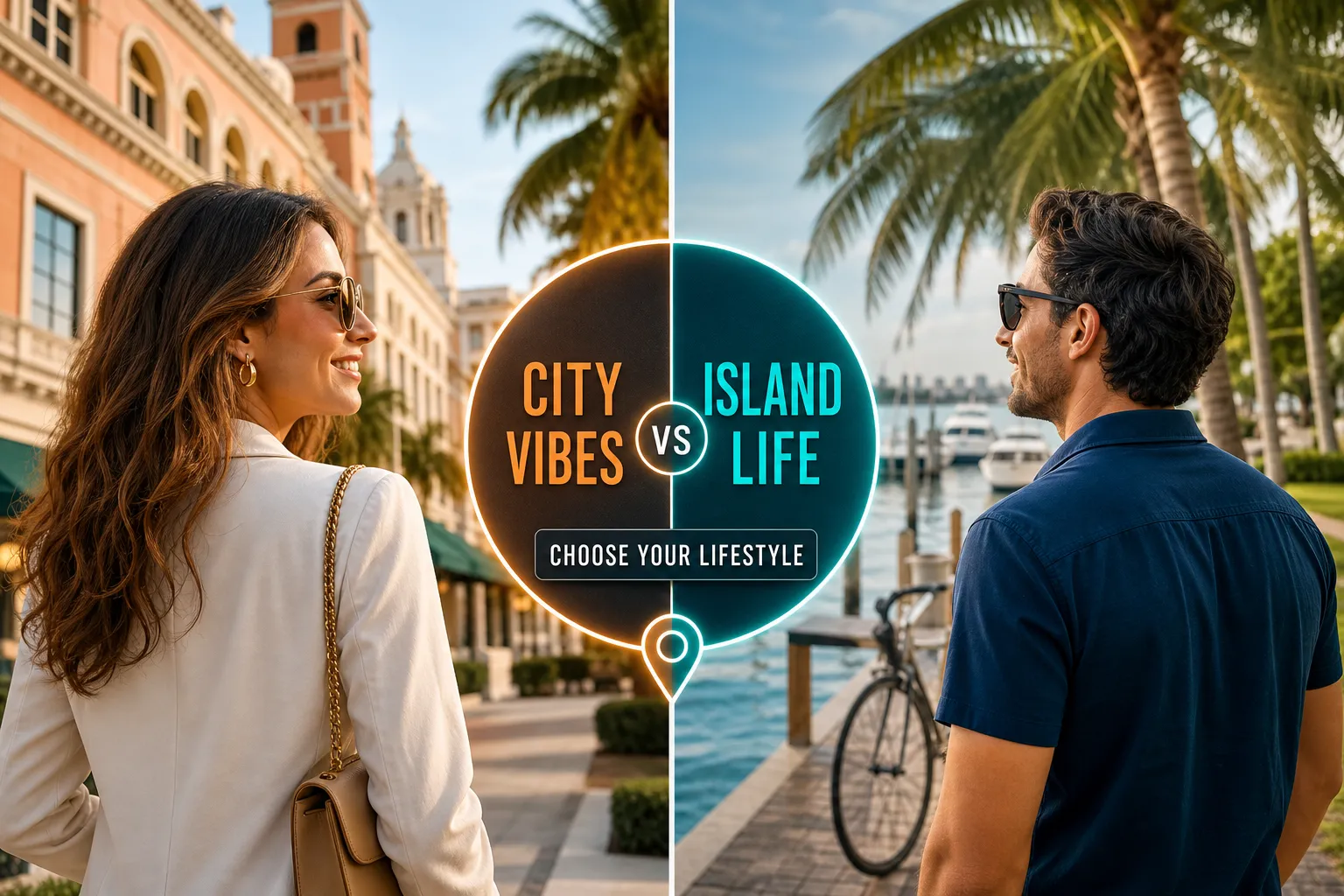
When weighing coral gables vs coconut grove, the core distinction comes down to this: Coral Gables suits buyers who want structured luxury, broader price entry points, and the widest range of school options. Coconut Grove suits buyers willing to pay a premium per square foot for an organic, canopy-lined lifestyle with tighter inventory and elite private school access. Both neighborhoods rank among Miami’s most desirable, but they serve genuinely different buyer profiles, and treating them as interchangeable will cost you money.
Both sit within Miami-Dade County, both carry strong brand recognition, and both attract high-net-worth buyers relocating from high-tax states or international buyers seeking wealth preservation in South Florida real estate. The comparison that follows is built on 2026 MLS data and the kind of neighborhood and building-level analytics that Andres Jara | South Florida Luxury Real Estate uses to help buyers cut through the noise and make decisions with institutional-grade clarity.
Key takeaways
- Price gap is real: Coconut Grove commands a markedly higher price per square foot than Coral Gables, with its closed sales clearing near $1,120 per square foot versus roughly $870 in the Gables.
- School priorities matter: Coral Gables offers the widest public and private school flexibility; Coconut Grove anchors one of Miami’s most prestigious private school corridors.
- Inventory dynamics differ: Coral Gables runs several times the annual transaction volume of Coconut Grove, giving buyers more options and investors more exit liquidity.
- Walkability varies widely: Coconut Grove’s village core is genuinely walkable; Coral Gables requires a car for most residential areas despite a strong amenity base.
- Safety trends are positive: Coral Gables reported a 12.15% drop in total crime in 2025; Coconut Grove consistently ranks among Miami’s safer neighborhoods.
- Building-level data decides close calls: Neighborhood medians are a starting point, not a strategy. Real decisions require closed-sale history, absorption rates, and off-market access at the address level.
Coral Gables vs Coconut Grove: 2026 Price and Cost-Per-Square-Foot Comparison
The 2026 price gap is wider than most buyers expect
The trailing twelve months of market data tell a clear story. Across all property types, Coral Gables closed at a median of roughly $1.5 million near $870 per square foot, while Coconut Grove closed at a median of about $2 million near $1,120 per square foot. Coconut Grove carries a per-square-foot premium of roughly 25 to 30 percent, which compounds into hundreds of thousands of dollars of additional cost on a comparable home before closing fees.
One important note on methodology before reading the table below: how a neighborhood’s boundaries are drawn, which property classifications are included, and which measurement period is used can materially shift the medians. Different series and boundary definitions can shift the exact figures, so treat the numbers here as a reliable directional benchmark and apply building-level analysis before committing to any specific address.
AreaMedian Sale Price (all types)Median $/Sq. Ft. (closed)12-Month Sales VolumeCoral Gables~$1,500,000~$870~614 salesCoconut Grove~$2,020,000~$1,120~87 sales
The condo gap is even more dramatic. Coral Gables offers a far deeper and more affordable condo market, with well over a hundred condos trading each year, while Coconut Grove’s condo market is small and priced at a steep premium. A buyer priced out of Coconut Grove condos is not simply shopping in the same market at a lower tier; they are in a different product category entirely.
Why Coconut Grove commands higher price per square foot
The answer is supply constraint. Coconut Grove recorded only about 87 closed sales over the trailing twelve months, where Coral Gables closed more than 600. Fewer transactions mean fewer comps, tighter inventory, and prices supported by scarcity rather than broad demand. Coral Gables’ larger geographic footprint and higher transaction volume create more price diversity across a wider range of product, which benefits buyers at different budget thresholds but also means more competition at the mid-range.
What does the character and architecture of each neighborhood actually feel like?
Coral Gables: Mediterranean Revival and master-planned grandeur
George Merrick’s 1920s vision produced a city built on Mediterranean Revival principles: coral rock gatehouse entrances, barrel-tile roofs, arched loggias, and wide landscaped boulevards like Coral Way and Miracle Mile. The Biltmore Hotel anchors the neighborhood’s identity as firmly now as it did a century ago, and the Venetian Pool remains one of the most architecturally significant public pools in the United States. For luxury buyers, this translates to substantial estates with manicured grounds, strict city ordinances that protect the aesthetic, and a consistent visual language across the market.
The most sought-after addresses in 2026 include Gables Estates for direct Biscayne Bay frontage and deep-water access, Cocoplum for gated waterfront living with private docks, and Riviera Drive for estate-scale homes beneath a mature oak and ficus canopy. The Biltmore and Country Club section draws buyers who want golf-course proximity combined with walkability to the city’s commercial core. Coral Gables has a formal, curated quality that appeals to buyers who want their neighborhood to look and feel as intentional as their home.
Coconut Grove: organic, canopy-covered, and arts-forward
South Florida’s oldest continuously inhabited neighborhood operates on a different set of principles. Banyan-shaded streets, an active arts community, a waterfront village feel, and a walkable commercial core around CocoWalk and the Dinner Key Marina area define the Grove’s character. The architecture is more eclectic, with styles ranging from mid-century modern to contemporary waterfront estates and no single visual template imposed across the neighborhood.
The most coveted addresses run along South Bayshore Drive, through the exclusive enclave of Tahiti Beach (roughly 30 homes with direct Biscayne Bay access), and into private communities like Hughes Cove and The Moorings. Waterfront and gated estates in these micro-pockets routinely trade in the $5 million to $15 million-plus range. The Grove lifestyle feels less formal and more layered, which appeals directly to buyers who want luxury without the rigidity of a planned community aesthetic.
Coral Gables vs Coconut Grove: Schools and Walkability
Public school landscape and zoning realities
Coral Gables offers a broader concentration of rated public schools, including Coral Gables Senior High with its IB and magnet programs, Ponce de Leon Middle, and several A-rated elementary options such as Sunset Elementary and Coral Gables Preparatory Academy. Coconut Grove has strong public elementary options, particularly Coconut Grove Elementary and George W. Carver Elementary on the Grove-Gables edge, but assigned middle and high school options depend heavily on the specific home address.
The practical advice for buyers in both neighborhoods is the same: verify the assigned school for the exact address before purchasing. Neighborhood reputation does not override attendance boundaries. Countywide magnet and choice programs, including Carver’s language track, West Laboratory School, MAST Academy, and the Design and Architecture magnet, are available through separate applications and can significantly expand the options available from any address.
Private school access and PreK-12 pathways
Coconut Grove’s private school cluster is a genuine differentiator. Ransom Everglades, Carrollton School of the Sacred Heart, and St. Stephen’s Episcopal Day School create one of Miami’s most concentrated private school corridors, offering clear PreK through 12 pathways within a short drive of most Grove addresses. For families where a specific school is a non-negotiable, proximity to these institutions can be decisive.
Coral Gables counters with greater overall variety across school types. Gulliver Academy and Gulliver Preparatory School cover elementary through secondary, Riviera Schools serves younger students, and St. Theresa Catholic School adds a parochial option. Westminster Christian and Belen Jesuit are accessible from both neighborhoods. Families who want flexibility across public magnet, Catholic, independent, and all-girls models will find more options anchored in Coral Gables.
Walkability and daily lifestyle amenities
In the coral gables vs coconut grove walkability comparison, each neighborhood wins on different terms. Coral Gables carries an overall Walk Score of 56, classified as somewhat walkable, with specific pockets like the Douglas and Crafts areas scoring in the high 80s and 90s. Much of the residential neighborhood is car-dependent. Coconut Grove’s walkability varies by zone: the area around CocoWalk scores near 98, while broader neighborhood averages sit between 60 and 74 depending on which section you measure.
For buyers who want to walk to dinner, a market, or the waterfront from their front door, Coconut Grove’s compact village core has a genuine edge. Coral Gables wins on overall amenity density across a wider geographic area, with the Miracle Mile shopping district, Biltmore Golf Course, the Venetian Pool, and a strong restaurant corridor concentrated along Giralda and Miracle Mile. The right answer depends on whether you value concentrated walkability or a broader amenity ecosystem.
Getting to work and the airport from each neighborhood
Coral Gables holds a clear transit advantage, served directly by the Metrorail Douglas Road and University stations, making it one of the more transit-accessible luxury neighborhoods in Miami-Dade. Coconut Grove has its own Metrorail station, but the walkable catchment around it is narrower. By car during off-peak hours, both neighborhoods reach Downtown Miami in 15 to 25 minutes; peak-hour traffic on U.S. 1 and I-95 can push those figures to 25 to 45 minutes.
For Miami International Airport, Coral Gables is slightly more convenient, with off-peak drive times of 10 to 15 minutes and peak times of 20 to 35 minutes. Coconut Grove runs 15 to 20 minutes off-peak and 25 to 40 minutes during rush periods. For executives making multiple weekly airport runs, that consistent gap adds up meaningfully across a year.
Which neighborhood has stronger investment potential right now?
Reading the 2026 data beyond the headline medians
Coral Gables carries roughly 8 to 9 months of supply overall, while Coconut Grove runs closer to 7 to 8 months, both healthier than the broader Miami-Dade condo market, which sits near 13 to 14 months of supply, conditions that firmly favor buyers in the condo segment.
Coral Gables’ far higher transaction volume (more than 600 closed sales versus about 87 in Coconut Grove over the same period) means more liquidity and more exit options for investors. Coconut Grove’s tighter inventory and higher price per square foot signal a supply-constrained market where scarcity supports prices, providing a strong floor while also limiting the opportunity to find a value buy without deep off-market access.
Why building-level data changes the investment conversation
Aggregate medians rarely tell the whole story at the block level. For a buyer choosing between a Coral Gables estate on a specific lot and a Coconut Grove bayfront home on South Bayshore Drive, the relevant comparison is not two neighborhood averages. It is the closed-sale history of comparable properties on those specific streets, the absorption rate by property type within that micro-pocket, and whether off-market transactions have set a price floor that public MLS data does not capture.
Andres Jara | South Florida Luxury Real Estate is built for exactly this level of analysis. The practice’s building-level research covers building-level profiles, closed-sale history by floor and unit, absorption rates by street and property type, and off-market sales that never appear in public data. An AI-powered advisor tool draws on live data across buildings and South Florida neighborhoods to model real scenarios against verified comps. In two markets where a $200-per-square-foot misjudgment compounds over a $2 to $3 million purchase price, that analytical depth is not a luxury; it is the difference between a well-priced acquisition and an overpaid one.
How to decide which neighborhood fits your priorities
Safety profile and what the data actually shows
Coral Gables operates as its own municipality with a dedicated police department, which produces transparent annual reporting and a proactive enforcement model. The 2025 data show total reported crime down 12.15% year-over-year, with particularly sharp declines in theft (down nearly 19%), motor vehicle theft (down 20%), and thefts from vehicles (down nearly 34%). The neighborhood recorded no homicides in 2025, and violent crime remains low relative to Miami-Dade overall.
Coconut Grove is policed by Miami PD rather than a separate municipal force, which makes precise annual crime counts harder to verify from official public sources. Miami PD district-level reporting and resident surveys consistently place the Grove among the city’s lower-crime neighborhoods, with property crime, vehicle break-ins and unattended-property theft in particular, representing a more relevant practical risk than violent crime. For both neighborhoods, common-sense precautions address the realistic exposure, and neither profile should materially affect a purchase decision.
Matching your priorities to the right choice
Choose Coral Gables if you want a broader price range across both single-family homes and condos, the widest school flexibility across public, magnet, and private options, higher transaction liquidity for future resale, and a formal Mediterranean architectural identity backed by strong municipal governance and consistent city ordinances.
Choose Coconut Grove if you are willing to pay a per-square-foot premium for tighter inventory, an organic urban character that planned communities cannot replicate, immediate proximity to Ransom Everglades or Carrollton for school-aged children, and the bayfront lifestyle premium along South Bayshore Drive or within gated enclaves like Tahiti Beach and Hughes Cove. The Grove’s supply constraint has historically supported strong price-per-square-foot floors, particularly in waterfront and gated product.
The next step is not choosing a neighborhood on paper. It is walking specific streets, reviewing closed-sale history on the blocks you are seriously considering, understanding what the absorption rate looks like at the address level, and talking to an agent who tracks both markets with building-level precision. Andres Jara | South Florida Luxury Real Estate is structured to deliver exactly that: 24 years of South Florida experience, bilingual service in English and Spanish, and access to off-market inventory across both neighborhoods.
Bottom line: Coral Gables vs Coconut Grove, which fits your priorities?
Coral Gables and Coconut Grove sit close together on the map but serve different buyer mindsets, different budgets, and different lifestyle priorities. One offers structured luxury with broader access and more transaction volume; the other offers a premium on organic character, scarcity, and bayfront proximity. Neither is the objectively better choice. The right answer depends entirely on what you are optimizing for.
What both markets share is the need for granular data before committing. Neighborhood medians obscure the variation that exists street by street and block by block. Closed-sale history within a specific building or enclave, absorption rates by property type, and off-market transactions that never reached the public MLS are what separate a confident, well-priced acquisition from a decision made on reputation alone.
Andres Jara | South Florida Luxury Real Estate covers both neighborhoods with the same building-level depth: building-level research, closed-sale history, off-market access, and an AI-powered advisor tool drawing on buildings across South Florida neighborhoods. Reach out to schedule a neighborhood walkthrough with verified closed-sale data in hand before committing to either market. That comparison looks materially different when you are standing on the right block with the right numbers in front of you.
Frequently Asked Questions
How can I access off-market listings in Coral Gables or Coconut Grove?
You can access off-market listings by contacting Andres Jara | South Florida Luxury Real Estate, which maintains off-market access across both neighborhoods. I offer building-level databases and an AI-powered advisor tool that draw on closed-sale history and off-market transactions to surface opportunities that don’t appear on the public MLS.
Is the luxury condo market favoring buyers right now?
Yes, the luxury condo segment currently favors buyers. Coconut Grove runs roughly 7 to 8 months of supply overall and the broader Miami‑Dade condo market sits near 13 to 14 months, conditions that provide buyer leverage.
Does Coral Gables have its own police department and how has crime trended recently?
Yes, Coral Gables operates as its own municipality with a dedicated police department and transparent annual reporting. In 2025 total reported crime dropped 12.15% year‑over‑year, with theft down nearly 19%, motor vehicle theft down 20%, thefts from vehicles down nearly 34%, and no homicides recorded that year.
Which neighborhood is more transit-accessible to Downtown and the airport?
Coral Gables is more transit-accessible, served directly by the Metrorail Douglas Road and University stations and offering slightly shorter drive times to Miami International Airport. Off-peak drives to Downtown are about 15 to 25 minutes from both neighborhoods, but Coral Gables typically reaches the airport in 10 to 15 minutes off-peak versus Coconut Grove’s 15 to 20 minutes.