
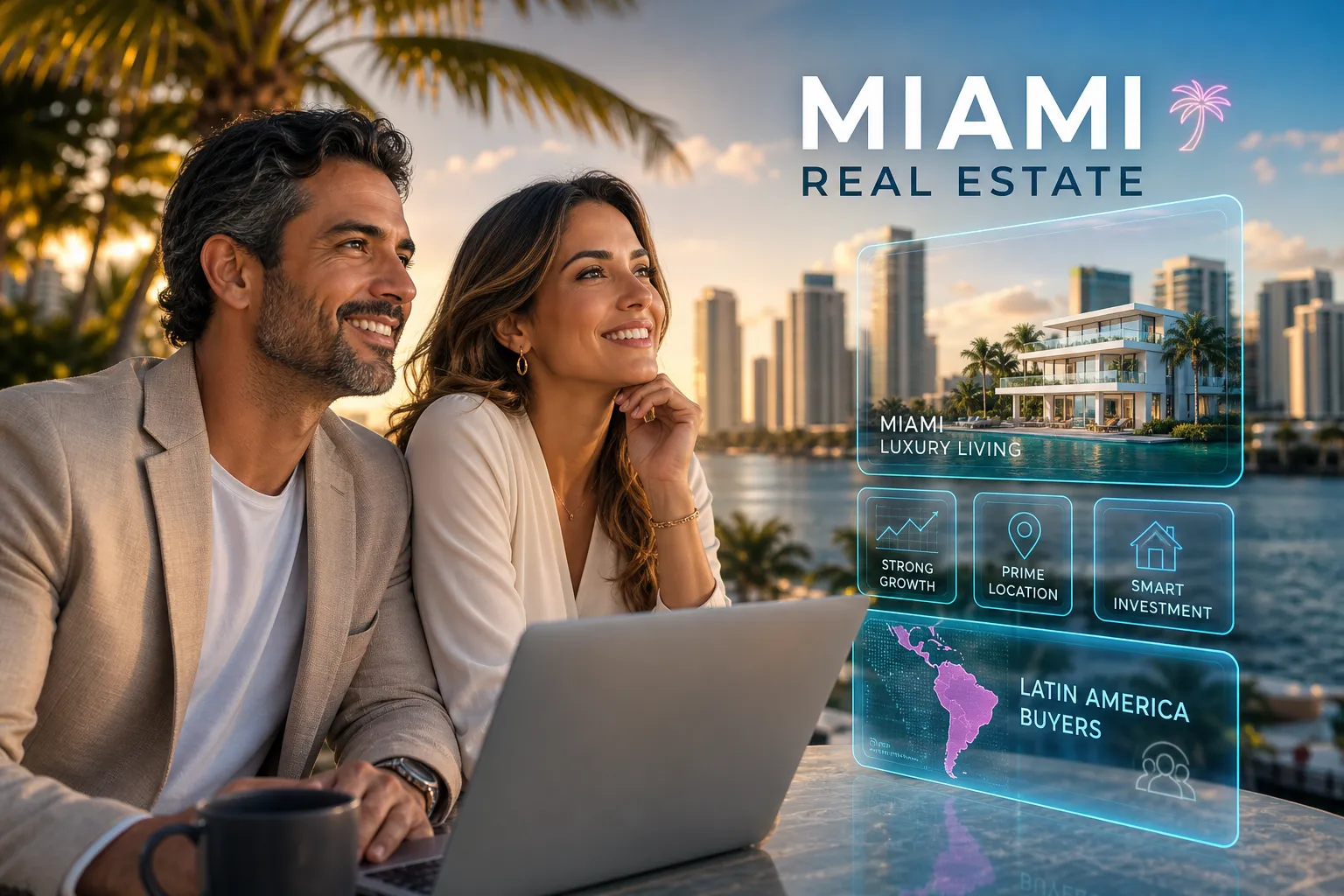
Latin American buyers in Miami now account for roughly 45% to 50% of all new-construction condo sales in South Florida, and that share has held steady through the reporting periods ending in late 2025. If you’re a buyer from Colombia, Argentina, Brazil, Mexico, or Venezuela, the purchase process is structured and navigable once you understand the rules: secure an ITIN if you need financing or plan to rent the property, open a U.S. bank account, choose a qualified title company, and understand FIRPTA withholding before you sign anything. With the right bilingual agent and proper pre-closing planning, both the process and the tax exposure are manageable. This guide covers everything you need to make a confident decision: where to buy, how to finance it, and what to budget for after closing.
The most recent MIAMI REALTORS® International Report (2025) confirms that Colombia leads all source countries at 15% to 18% of South Florida international sales, followed by Argentina at 12% to 13%, Mexico and Brazil at 7% each, and Venezuela at 5% to 6%. Colombians and Argentines alone represent roughly 27% of all international closed sales in the region. That concentration of demand in a handful of countries shapes everything from which buildings presell fastest to which neighborhoods carry the most Latin American cultural infrastructure.
Key takeaways
- Market share is significant: Latin American buyers in Miami represent approximately 45%–50% of new-construction condo sales in South Florida, based on overlapping 18-to-22-month reporting windows through mid-2025, with Colombians and Argentines leading all source countries.
- Cash dominates: 68% of international buyers in South Florida paid entirely in cash, giving them a clear negotiating advantage and faster closing timelines.
- Neighborhood concentration matters: Downtown Miami (99% Latin American share of international buyers), Coconut Grove (97%, note: based on a small international transaction sample), and Coral Gables (88%) show the highest concentrations.
- FIRPTA is unavoidable: When you eventually sell, 15% of the gross sales price will typically be withheld and remitted to the IRS unless you apply for a reduced withholding certificate using IRS Form 8288-B. Exceptions and lower withholding rates may apply depending on the transaction structure.
- Estate tax exposure is real: Non-resident alien property owners face U.S. federal estate tax on U.S. assets above $60,000 at rates up to 40%. An LLC or a properly structured estate planning vehicle is worth discussing with a cross-border tax attorney before closing.
- Bilingual expertise changes outcomes: The right agent translates more than documents, they translate the market, the building data, and the negotiation dynamics for buyers operating from abroad.
Why Latin American buyers keep choosing Miami in 2026
The core driver is straightforward: dollar-denominated assets in a stable legal system. Currency depreciation in Argentina, Venezuela, and Colombia has made holding local savings increasingly expensive, and Miami real estate offers a reliable store of value that local markets simply cannot replicate. Pre-construction purchases are especially appealing because staged payment schedules allow buyers to move capital into dollars in phases across the construction timeline, a practical workaround for countries with capital controls.
Beyond currency protection, 91% of surveyed international buyers in South Florida acquired property for investment or second-home purposes. The motivations they cite reinforce one another: security (35%), location (33%), and investment potential (25%). Miami delivers on all three. Direct flights from Bogotá, Buenos Aires, São Paulo, and Mexico City run daily. Spanish-language services are widely available across Brickell, Coral Gables, and Aventura. Florida’s lack of a state income tax is a planning advantage for buyers establishing U.S. tax residency, and the state’s favorable property laws give owners a level of legal protection that is rare in Latin American markets.
Which Miami neighborhoods are Latin American buyers actually targeting?
The data is more specific than most buyers realize. The 2025 MIAMI REALTORS® report, covering an 18-month period ending June 2025, found that Downtown Miami led all submarkets with 1,341 international condo sales, and 99% of those buyers were Latin American. Brickell followed with 733 international transactions and a 79% Latin American share. These two urban submarkets attract Colombian, Argentine, Brazilian, and Mexican buyers seeking investment-grade units with strong rental demand and long-term appreciation potential.
Coral Gables and Coconut Grove serve a different buyer profile. Coral Gables registered an 88% Latin American share of international buyers; Coconut Grove reached 97%, though that figure reflects a small sample of international new-construction transactions in the report’s dataset. Buyers with families, particularly from Brazil, Mexico, and Colombia, gravitate toward these neighborhoods for top-rated schools, single-family homes, walkable streets, and a quieter pace that Brickell doesn’t offer. The table below summarizes key submarkets by Latin American buyer concentration.
Miami neighborhood breakdown for Latin American buyers
NeighborhoodLatin American share of int’l buyersPrimary buyer profileProperty typeDowntown Miami99%Colombian, Argentine, Brazilian investorsUrban condos, investment unitsCoconut Grove97% (small sample)*Family-oriented buyers from Brazil, MexicoSingle-family homes, luxury condosCoral Gables88%Families from Colombia, Brazil, MexicoSingle-family homes, estatesBrickell79%Argentine, Colombian buyers; pied-à-terreLuxury high-rise condosMiami Beach77%Argentine, Venezuelan, Brazilian buyersOceanfront condos, branded residencesSunny Isles Beach / AventuraNot separately quantified in reportLifestyle buyers, second-home seekersOceanfront towers, luxury condos
*Coconut Grove’s 97% figure is derived from a small number of reported international transactions; treat it as directional rather than statistically definitive.
Sunny Isles Beach and Aventura round out the corridor. Based on general market patterns, Sunny Isles draws Argentine and Venezuelan buyers toward oceanfront branded buildings, while Aventura offers luxury inventory at slightly lower price points than Miami Beach, attractive for buyers whose priority is rental yield alongside lifestyle access.
How the buying process works for international buyers
The transaction follows six practical steps. First, establish your identification: a valid passport works for closing, but an ITIN is required if you plan to finance, report rental income, or eventually claim a FIRPTA refund. Apply for your ITIN early, since IRS processing can take several weeks. Second, open a U.S. bank account or prepare your wire transfer documentation and source-of-funds evidence, title companies and lenders will require this for compliance purposes.
Third, engage a bilingual agent with confirmed off-market access before you start touring. Fourth, make your offer and deposit funds into escrow with a U.S. title company experienced in international transactions. Fifth, complete due diligence: inspect the unit, review HOA financials and special assessments, examine the building’s reserve study, and verify the condo’s warrantability if you’re financing. Sixth, close and receive title. Cash buyers typically close in 30 to 45 days; financed transactions take 45 to 60 days.
Documents you’ll need at closing include a valid passport, three to six months of bank statements as proof of funds, source-of-funds documentation for compliance review, and any IRS forms related to FIRPTA. If you’re a foreign seller at a future sale, IRS Form 8288-A documents the withholding; Form 8288-B is the application to request a reduced withholding certificate, which must be filed before or at closing and can take up to 90 days for IRS processing.
Financing options for Latin American buyers in Miami: what’s actually available
The 68% cash purchase rate among South Florida international buyers reflects both preference and practicality. Cash closings move faster, require less documentation, carry stronger negotiating leverage, and eliminate exposure to U.S. interest rate risk. For buyers from countries with capital controls, pre-construction staged payments serve as an effective capital transfer mechanism, spreading the transaction across the construction timeline without triggering a single large wire event.
Loans for Latin American buyers in Miami
Foreign national mortgage programs do exist, and they are worth understanding. Specialty lenders and private banks offer portfolio loans with requirements that differ from standard U.S. financing. Typical conditions include:
- A 30% to 40% down payment for condos
- Twelve months of reserves covering principal, interest, taxes, insurance, and HOA dues
- International bank statements and credit references
- Documented source of funds
Rates run above conventional U.S. mortgage rates, and the building itself must pass lender review, warrantability, HOA reserve status, litigation exposure, investor concentration, and completion percentage all affect approval.
Cash vs. financed purchases for Miami Latin American buyers
New-construction buildings may require at least 50% of units to be closed or under contract before a lender will approve higher loan-to-value financing. DSCR (debt-service coverage ratio) loans are an option for buyers purchasing for rental income; underwriting is based primarily on projected rent rather than personal foreign income. Get written term sheets from at least three lenders and have them review the specific building before you waive any financing contingency.
Tax implications Latin American buyers can’t afford to overlook
FIRPTA is the rule that surprises most buyers when they eventually sell. When a foreign national sells U.S. real estate, the buyer or settlement agent must withhold 15% of the gross sales price (the “amount realized”) and remit it to the IRS within 20 days of closing using IRS Form 8288 and Form 8288-A. This is a withholding mechanism, not a final tax. If your actual capital gain is less than 15% of the sales price, you can apply for a reduced withholding certificate using IRS Form 8288-B. That application must be filed before or at closing, and the IRS typically takes up to 90 days to process it. Exceptions and lower withholding rates, including 0% and 10%, may apply for qualifying residence purchases. Plan for this timeline before you list.
Ongoing ownership costs for a non-resident foreign owner in Miami-Dade run approximately 1.5% to 2.0% of assessed value annually in property taxes. The Florida homestead exemption, which reduces that bill for primary residents, is not available to buyers using the property as a second home or investment. A $1 million condo carries roughly $15,000 to $20,000 in annual property taxes; a $5 million oceanfront unit approaches $85,000 per year. Add HOA fees and South Florida’s elevated insurance premiums, and the total carrying cost often surprises buyers who modeled only the purchase price.
The most overlooked risk is U.S. federal estate tax for non-resident alien owners. Any U.S. situs property above $60,000 in value is subject to estate tax at rates up to 40% when the foreign owner dies. Purchasing through an LLC or foreign corporation is a common mitigation strategy, but it must be structured before closing with a U.S. cross-border tax attorney. Florida has no state estate or inheritance tax, a genuine advantage, but the federal exposure is the issue that demands attention.
How Andres Jara helps Latin American buyers navigate Miami’s market
Andres Jara | South Florida Luxury Real Estate has built a practice centered on exactly this buyer: affluent, cross-border, often purchasing remotely, and operating with a set of concerns, risk tolerances, and due diligence expectations that differ meaningfully from domestic U.S. buyers. Buyers from Colombia, Argentina, Brazil, Venezuela, and Mexico are not an occasional segment of this practice, they are the core. Bilingual service in English and Spanish is not a line item on a marketing brochure; it is the foundation of every contract review, every HOA document analysis, and every closing conversation.
The operational approach centers on building-level intelligence across South Florida condo buildings, supported by a building-level research updated daily. Unit-level inventory, floor plan data by line and stack, closed-sale history, and private-sale records reduce the need for multiple in-person tours. A buyer in Bogotá can evaluate specific floor lines, stack exposures, and internal pricing trends within a single Brickell building before stepping on a plane, institutional-grade research delivered through a single agent affiliated with Douglas Elliman.
That research depth pairs with geographic coverage spanning Miami-Dade, Broward, and Palm Beach counties. Buyers exploring Brickell, Coral Gables, Coconut Grove, Sunny Isles Beach, Aventura, Fort Lauderdale, and Boca Raton work with one bilingual point of contact rather than coordinating across multiple agents in multiple submarkets. If you’re ready to start your search with building-level data behind every recommendation, contact Andres Jara | South Florida Luxury Real Estate directly.
The bottom line for buyers ready to move forward
Miami’s appeal to Latin American buyers in 2026 is data-backed and durable. Dollar-denominated assets, world-class lifestyle, legal stability, and a cultural infrastructure that feels familiar make South Florida the dominant destination for wealth preservation from Buenos Aires to Bogotá. Both the process and the tax exposure are manageable, provided planning happens before the contract is signed, not after.
Whether your target is a Brickell investment condo, a Coral Gables family home, or an oceanfront unit in Sunny Isles Beach, the first step is the same: work with an agent who has done this before, speaks your language, and has access to the inventory that fits your goals. Contact Andres Jara | South Florida Luxury Real Estate to start your search with decades of South Florida experience, off-market access, and building-level data across South Florida neighborhoods behind every recommendation.
Frequently Asked Questions
Do I need an ITIN to buy a Miami property as a Latin American buyer?
You need an ITIN if you plan to finance the purchase, report rental income, or claim a FIRPTA refund. Apply early because IRS processing can take several weeks, and having an ITIN supports mortgage applications and tax filings related to rental or eventual sale proceeds.
How long will it take to close my purchase if I pay cash versus using a loan?
Cash buyers typically close in 30 to 45 days, while financed transactions generally take 45 to 60 days. Financing requires lender reviews of the building’s warrantability and reserves, and specialty foreign-national loans add documentation and reserve requirements that extend timelines.
What ongoing carrying costs should I budget for after closing?
Expect property taxes of roughly 1.5% to 2.0% of assessed value annually, plus HOA fees and higher insurance premiums in South Florida. For example, a $1 million condo carries about $15,000 to $20,000 per year in property taxes, and a $5 million oceanfront unit approaches $85,000 annually before HOA and insurance.
How can I reduce U.S. estate tax exposure on a Miami property?
You can mitigate federal estate tax exposure by structuring ownership through an LLC or another estate-planning vehicle, but it must be set up before closing with a U.S. cross-border tax attorney. U.S. situs property above $60,000 is subject to federal estate tax for non-resident aliens, so early planning is essential to avoid potential rates up to 40%.
Who should I contact to start a Miami search tailored to Latin American buyers?
Contact Andres Jara | South Florida Luxury Real Estate to start your search with bilingual, building-level data and off-market access. I cover Miami-Dade, Broward, and Palm Beach counties and provide inventory, floor plan data, and market intelligence across South Florida neighborhoods to support remote and in-person buyers.