
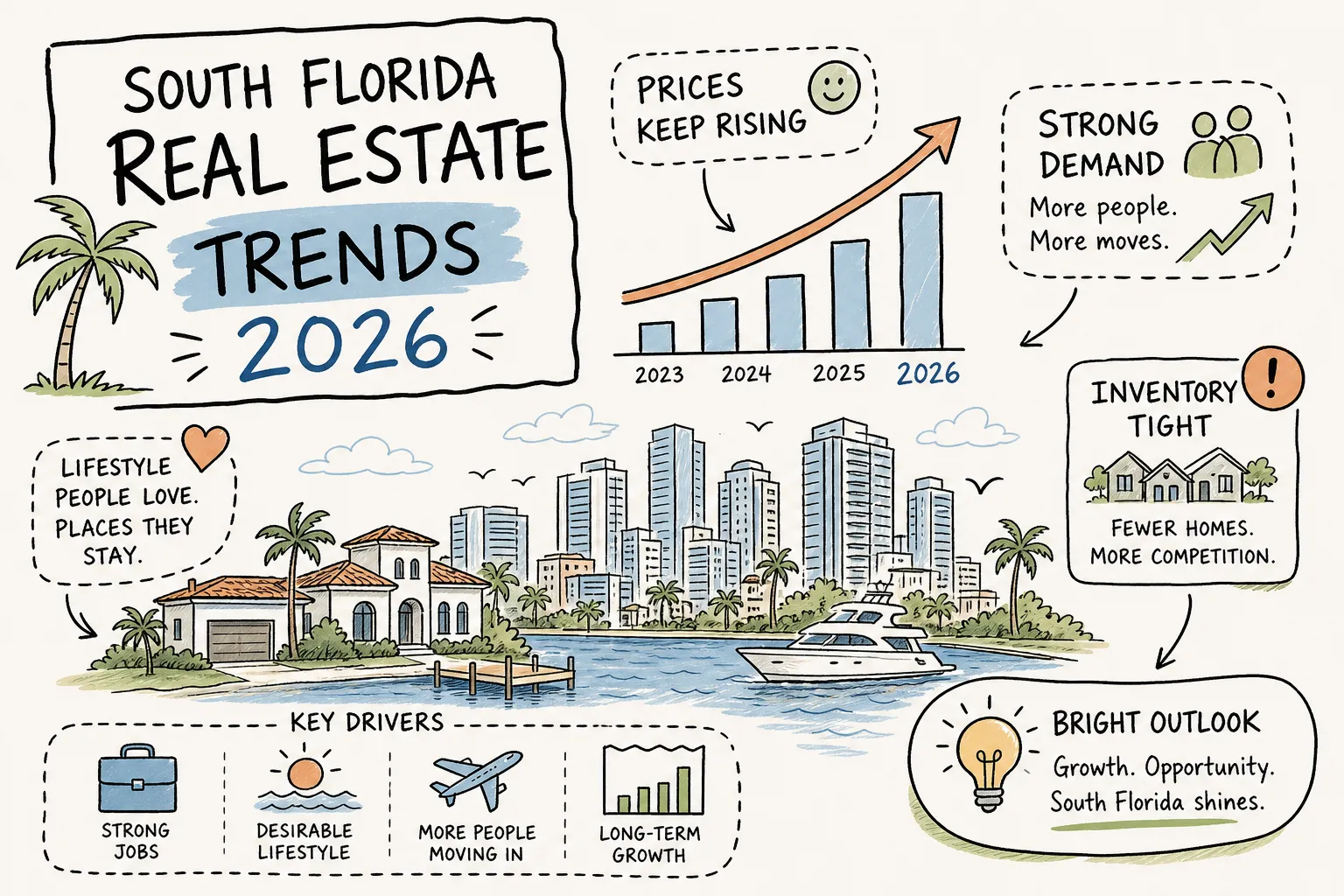
South Florida real estate trends in 2026 look stable from 30,000 feet. Median prices are up across all three counties, sales volume has grown for eleven consecutive months in Miami-Dade, and the rental market is finally absorbing more units than it delivered. But beneath those headline figures, the market is splitting in ways that county averages simply cannot capture. Single-family homes are tightening fast. Condo inventory remains elevated. Rental demand has turned a corner, but luxury apartments are still competing for tenants. The numbers point in the same direction on the surface and diverge sharply underneath.
This report covers south Florida real estate trends across all three counties, Miami-Dade, Broward, and Palm Beach, including prices and appreciation, inventory and sales velocity, South Florida rental trends, seller behavior, and what each of those trends means for buyers, sellers, and investors. The county-level data is where most market reports stop. This one goes further and explains why building-level intelligence is the only way to turn those county figures into an actual decision.
Where Prices Stand Across Miami-Dade, Broward, and Palm Beach
Single-family median prices have risen year over year across all three counties, with Miami-Dade and Broward both in the high six figures and Broward posting the strongest appreciation of the three, reflecting its position as the relative-value entry point for buyers priced out of Miami’s core luxury submarkets. All three counties are moving in the right direction, but this is a measured, affordability-constrained environment, mortgage rates and debt-service burdens remain meaningfully higher than they were in 2021, and year-over-year price gains are running at roughly one-fifth the pace of that cycle’s peak appreciation.
The picture shifts when condos enter the equation. The all-home-types median for Miami-Dade runs around $557,000 on a trailing-twelve-month basis, well below the single-family figure. Elevated condo supply is contributing to greater buyer negotiating leverage and giving purchasers more room to maneuver than the single-family data suggests. That divergence between the two property types is one of the defining features of the 2026 South Florida housing market, and it runs through every other metric in this report.
South Florida Real Estate Trends: Inventory and Sales Velocity
Single-Family Inventory
Active single-family inventory has fallen sharply year over year across all three counties, compressing months of supply into single digits. Palm Beach now has the tightest single-family market in the region, and all three counties are approaching or inside seller-favorable territory. Pending single-family sales and total closings have been rising, with Miami-Dade posting a long run of consecutive months of volume growth.
Condo Inventory
The condo market is improving but tells a different story. Active condo inventory has fallen more modestly, and months of supply remains firmly in buyer territory, running well into the double digits in Miami-Dade and Broward and elevated in Palm Beach. Marketing time for Miami condos runs considerably longer than the single-family pace. The Broward County housing market and Palm Beach real estate data both confirm the same pattern: single-family is a seller’s market, condos are still a buyer’s market. That distinction is not a nuance. It changes everything about how you negotiate, price, and time your move.
South Florida Rental Trends: Stabilization After Three Years of Correction
South Florida rental trends in 2026 are best described as a slow turn from deterioration to stability. The regional median apartment rent has come down meaningfully from its 2022 peak, but year-over-year rent growth has returned across all three counties, each outpacing the national rate, which signals that South Florida is normalizing faster than the broader U.S. market.
The structural shift is in absorption. Over the past year, renters signed leases on more units than were completed for the first time in three years, as demand finally outpaced supply. Overall vacancy sits near the national rate regionally, with Miami’s metro running below it. The caveat matters: luxury and market-rate rental buildings still carry elevated vacancy, while well-located Class A and workforce properties run near full occupancy. A large pipeline of units remains under construction, so supply pressure has not disappeared, it is leveling off, not clearing.
For buyers, this translates to continued softness in luxury rental comps. For sellers and developers, the stabilization in demand signals improving fundamentals. For investors, the distinction between asset classes within the rental sector has rarely mattered more.
What Seller Behavior Signals Are Actually Saying
The inventory picture in 2026 is not purely a demand story. A significant portion of the inventory decline is coming from sellers pulling their listings rather than closing sales. Miami has recorded one of the highest delisting-to-new-listing ratios among major U.S. metros, a pattern that has carried into 2026. Sellers who cannot achieve their target price are increasingly choosing to withdraw rather than negotiate, which keeps supply artificially tighter than actual buyer absorption would justify.
Despite longer marketing times and elevated condo supply, only a minority of active Miami listings have taken price cuts in the most recent comparable period. Sellers remain anchored to 2021 and 2022 valuations even as days-on-market climbs. The market is bifurcating between patient sellers who withdraw and motivated sellers who relist at more realistic prices and close. For buyers, that means negotiating room exists, particularly in the condo segment, but it is difficult to quantify from county-level data alone. You need to know whether a specific building’s internal absorption is 6 months or 14 months before you can assess how much leverage you actually have.
Foreclosure activity adds another layer. Miami-Dade foreclosure filings have risen year over year, with meaningful growth in foreclosure starts. That sounds alarming but still represents a small fraction of the housing stock, modest by historical standards. The stress is concentrated below the $700,000 price point among owners who purchased near the 2021 peak and now face elevated insurance, HOA reserves, and financing costs. This is normalization, not a 2008-style cycle, and the luxury market is largely insulated from it.
What the Trends Mean for Buyers, Sellers, and Investors by County
In Miami-Dade, condo buyers have meaningful leverage with well over a year of supply and long average marketing timelines. International and Latin American investors will find the condo segment offers the widest selection and the most room to negotiate, particularly in older non-luxury buildings facing structural compliance and reserve-funding pressure. Single-family buyers, by contrast, should expect faster timelines and less room to maneuver. The luxury condo segment is running on a different track, with transactions and average prices rising even as the broader market softens. Branded and waterfront towers are absorbing at a measurably faster pace, while older, less differentiated inventory is not.
Palm Beach has the tightest single-family supply in the region, and buyers face limited options as the county continues setting records for $10 million-plus sales. The condo segment offers more breathing room, though Palm Beach luxury condo average prices have softened even as transactions rose, reflecting a wide dispersion between Palm Beach Island trophy properties and inland product. Sellers in all three counties retain pricing power on the single-family side but need to set expectations based on building-specific comparables, not ZIP code averages.
Broward showed the strongest year-over-year appreciation among the three counties and produced strong luxury condo transaction growth, making it one of the most dynamic markets for investors targeting the mid-luxury segment. Single-family buyers in Broward need pre-approved financing, clear decision criteria, and the willingness to move quickly. Rental investors in Broward should focus on workforce-oriented properties, where occupancy is running near full rather than the elevated vacancy hitting luxury buildings.
Why County-Level Data Is Only Half the Picture
A Miami-Dade county median covers everything from a distressed condo in North Miami to a penthouse in Brickell. Those two properties are not in the same market, and treating them as if they are leads to mispriced listings and uninformed offers. The same principle applies across the Broward County housing market and Palm Beach: a building in downtown Fort Lauderdale with 14 months of internal supply and one in Aventura with 6 months are telling very different stories, even if the county figure reads 10 months. Even within Miami-Dade, county-level data can show well over a year of condo supply while a specific branded tower carries a dramatically different absorption profile. Both figures are accurate. Neither tells the full story alone.
Andres Jara | South Florida Luxury Real Estate tracks south Florida real estate trends at the building level across South Florida neighborhoods and buildings, drawing from an building-level research that is refreshed daily with unit inventory, floor plan data, closed-sale history, and absorption rates specific to each building. That granularity answers the questions county data cannot: Is this building absorbing faster or slower than the market? What did the comparable unit two floors down actually close for? How many units are competing with this listing right now?
Final Takeaway: South Florida Real Estate Trends Heading Into 2027
South Florida real estate trends in 2026 point to a market in selective recovery. Single-family homes are in demand across all three counties, condo inventory remains elevated but improving, and the rental market has turned a meaningful corner after three years of correction. The county picture tells you the direction. Building-level data tells you the opportunity.
The signals worth watching as 2026 closes: delist rates and withdrawal patterns, permit slowdowns in Miami-Dade multifamily, foreclosure completion rates rather than just filings, and luxury absorption at the building level in Brickell, Sunny Isles Beach, and West Palm Beach. Those will be the early indicators for where the South Florida market forecast heads into 2027. Whether the selective recovery broadens into the condo segment or stays concentrated in single-family and branded luxury will depend on supply, insurance costs, and whether motivated sellers finally set prices the market will accept.
If you want to move past county averages and understand what is actually happening inside the buildings you are considering, reach out to Andres Jara for a building-specific analysis covering inventory, closed comps, floor plan comparisons, and absorption rates, the level of detail that turns market data into a real decision.